Why Choose Alloy Powder for Global Sourcing?
Global buyers increasingly view Alloy Powder as a strategic manufacturing input, not simply a commodity. The 2024 Wohlers Report valued the broader additive manufacturing market at $20.035 billion in 2023. However, this figure does not represent Alloy Powder alone. That distinction matters. It prevents exaggerated market claims.
For international sourcing teams, powder quality affects build consistency, surface finish, fatigue performance, and production yield. A reliable supplier should provide lot-specific certificates, particle-size distribution, chemistry results, oxygen readings, and traceability records. Buyers should also review sieve analysis and apparent density before approving samples. Small deviations become expensive. They can produce failed builds, delayed shipments, or costly requalification.
Terry Wohlers, founder of Wohlers Associates, stated, “The AM industry continues to grow, but at a slower rate than in previous years.” His observation supports a careful sourcing strategy. Growth creates opportunity, but it also encourages rushed supplier decisions. ISO and ASTM requirements can strengthen evaluations, especially for aerospace, medical, automotive, and energy applications. Still, certification alone does not guarantee consistent Alloy Powder performance. Supplier audits, retained samples, packaging inspections, and controlled storage remain necessary.
Global sourcing can improve capacity access, pricing flexibility, and supply resilience. Yet distance introduces risks, including customs delays, inconsistent documentation, and communication gaps. A practical approach compares total landed cost, not only the quoted powder price. The best supplier is not always the cheapest. It is the partner that combines metallurgical expertise, transparent data, stable production, and responsive technical support. A stronger process may begin with a small trial order. That is less impressive on paper, but often more reliable in practice.
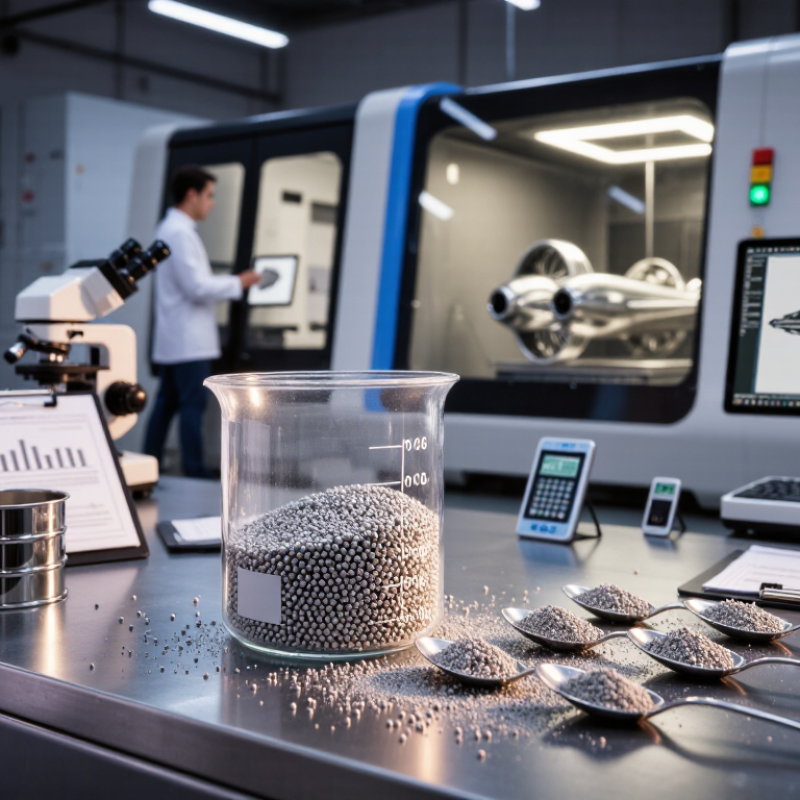
Alloy powder is a finely processed metal blend containing two or more elements, such as iron, nickel, cobalt, aluminum, or copper. Its composition can be adjusted to improve strength, corrosion resistance, heat tolerance, or electrical performance. Unlike solid bar, powder offers greater flexibility during manufacturing. Small particles can fill molds, form coatings, or build complex shapes layer by layer. Its behavior depends on particle size, shape, purity, and production method.
Alloy powder is used in powder metallurgy, additive manufacturing, thermal spraying, brazing, and specialized surface treatments. For example, a manufacturer may use spherical powder for smoother flow in a printer. Irregular particles may provide better packing in a pressed component.
In practical sourcing, material certificates, batch traceability, oxygen content, and particle-size distribution deserve close review. A low price can hide inconsistent chemistry or poor flow. That mistake is expensive.
Tips: Match the powder to the process, not only the final product. Ask for recent test data and sampling details. Confirm storage conditions, because moisture can change powder performance. Compare several batches when possible. No powder is perfect. Engineers should test actual production results before approving large global orders. Clear specifications and honest communication reduce avoidable surprises across borders.
Alloy powder suits global sourcing because its properties can be measured, compared, and documented across borders. Particle-size distribution affects flow, packing density, and final part quality. Spherical particles usually feed more consistently through automated systems. However, perfect sphericity is not guaranteed. Satellite particles and irregular shapes can still appear after atomization.
ISO/ASTM 52907:2019 identifies key powder controls, including morphology, apparent density, flow rate, moisture, and chemical composition. These measurements help buyers compare suppliers using evidence rather than attractive specifications. The 2024 Wohlers Report valued the global additive manufacturing industry at about 20.0 billion US dollars in 2023. Its reported growth also reflects stronger demand for qualified metal feedstock. Alloy powders support this trend because one formulation can serve multiple production regions when process parameters remain controlled.
High purity is another practical advantage. Low oxygen, nitrogen, and moisture levels can reduce porosity and unstable melting in metal-based production. Narrow particle distributions also simplify parameter development and reduce screening waste. Traceable batch numbers, test certificates, and sealed packaging make remote purchasing more reliable. Yet certificates alone are not enough. Independent sampling may reveal differences between batches, especially after long storage or repeated transport. Buyers should verify powder reuse limits, packaging integrity, and actual flow behavior before approving large volumes. That extra step costs time, but ignoring it can cost far more.
| Property / Sourcing Dimension | Typical Data or Range | Why It Matters in Global Sourcing | Common Evaluation Method |
|---|---|---|---|
| Alloy Chemistry | Element concentrations are normally specified in weight percent with controlled limits for major and trace elements. | A clearly defined chemical specification supports equivalent purchasing from qualified suppliers in different regions. | Optical emission spectroscopy, X-ray fluorescence, or inductively coupled plasma analysis. |
| Particle-Size Distribution | Common powder cuts include approximately 15–45 µm for some powder-bed processes, 45–106 µm for many thermal-spray applications, and 45–150 µm for selected metal-injection or press-and-sinter feedstocks. | Particle size influences packing, flow, deposition efficiency, surface finish, and process compatibility. | Laser diffraction, sieve analysis, or dynamic image analysis. |
| Particle Morphology | Gas-atomized powders are often predominantly spherical; water-atomized powders generally have more irregular or satellite-containing particles. | Spherical particles typically provide better flow and packing, while irregular particles may be selected for specific compaction or cost requirements. | Scanning electron microscopy and image analysis. |
| Flowability | Hall flow values for free-flowing metal powders are commonly reported in seconds per 50 g; a lower value generally indicates easier flow under the same test conditions. | Consistent flow helps reduce feeding interruptions and improves repeatability across automated equipment and overseas production sites. | Hall flowmeter or Carney flowmeter testing, typically reported with the test standard. |
| Apparent and Tap Density | Many metal powders have apparent densities around 2–6 g/cm³, depending on alloy composition, morphology, and particle-size distribution. | Density affects container utilization, freight calculations, powder dosing, storage volume, and part shrinkage during consolidation. | Apparent-density and tap-density testing using calibrated cylinders and standardized tapping equipment. |
| Oxygen, Nitrogen, and Moisture | Limits are alloy- and process-specific; reactive alloys and additive-manufacturing powders generally require especially low interstitial contamination and controlled moisture. | Controlled contamination reduces porosity, oxidation, embrittlement, and variation during melting or sintering. | Inert-gas fusion analysis for oxygen and nitrogen; loss-on-drying or Karl Fischer methods for moisture. |
| Thermal and Corrosion Performance | Performance depends on alloy family; nickel-, cobalt-, iron-, aluminum-, copper-, and titanium-based systems are selected for different combinations of heat resistance, strength, conductivity, or corrosion resistance. | A broad alloy portfolio allows buyers to match powder chemistry with regional application requirements without changing the overall powder-processing concept. | Tensile testing, hardness testing, oxidation exposure, salt-spray testing, or immersion corrosion testing as applicable. |
| Packaging and Shelf Stability | Powders are commonly supplied in sealed, moisture-resistant containers; reactive materials may require inert-gas filling or additional handling controls. | Standardized packaging, lot identification, and storage instructions help protect material quality during international transport and warehousing. | Package-integrity inspection, moisture verification, lot traceability, and documented storage-condition review. |
| Batch-to-Batch Consistency | Key release parameters may include chemistry, particle-size distribution, morphology, flow rate, density, and interstitial content. | Consistent batches simplify supplier qualification, incoming inspection, production transfer, and multi-country procurement. | Certificate-of-analysis review, statistical process control, retained-sample testing, and periodic third-party verification. |
| Reusability and Material Efficiency | In some powder-based processes, unused powder may be recovered and reused after sieving and quality testing; the allowable reuse cycle depends on the alloy and process. | Potentially lower material waste and more predictable consumption can improve total landed cost and supply planning. | Post-process particle-size, chemistry, flowability, and contamination checks before reuse. |
Note: The values and ranges shown are representative industry guidance only. Actual requirements vary by alloy composition, powder-production route, application, equipment, and applicable international or customer specifications.
Why Choose Alloy Powder for Global Sourcing?
How Does Global Sourcing Affect Alloy Powder Quality and Supply?
Global sourcing can widen access to alloy powders with different chemistries, particle sizes, and production methods. It can also reduce dependence on one regional supplier. In practical purchasing work, quality often changes between batches, even when specifications appear identical. Moisture, oxidation, and irregular particle shapes may affect flow and final performance. Small errors spread.
Reliable buyers should request full composition data, particle-size results, lot numbers, and packaging details. Independent testing can verify oxygen content, density, and contamination levels before shipment. Supplier audits also reveal whether storage areas are dry and properly sealed. A certificate can look complete and still miss handling damage. That risk deserves attention.
Supply continuity depends on more than production capacity. Port delays, customs reviews, seasonal disruptions, and limited transport options can extend delivery times. Dual sourcing may improve resilience, but it can introduce small differences in powder behavior. These differences may require process adjustments or additional qualification work. Clear technical agreements should define acceptable variation, inspection points, and replacement procedures. Global sourcing is useful, but it is not automatically safer or cheaper. Careful records and honest communication remain essential.
How Does Global Sourcing Affect Alloy Powder Quality and Supply?
The chart presents commonly used engineering screening windows for gas-atomized alloy powders used in powder metallurgy and additive manufacturing. Global sourcing can improve supply continuity and capacity, but particle-size distribution, oxygen level, tap density, and morphology should be verified for every batch because acceptance limits vary by alloy, process, and applicable specification. Reference methods include ISO/ASTM 52907 and ASTM F3049.
Alloy powder supports consistent production across aerospace, automotive, energy, and medical equipment applications. Its fine particle size can improve blending, coating, and additive manufacturing results. However, global buyers should evaluate suppliers beyond price and attractive specifications.
Check the supplier’s material expertise, production controls, and testing capabilities. Ask for chemical composition reports, particle-size distribution, flowability data, and batch traceability. Independent laboratory verification adds confidence when tolerances are strict. Reliable suppliers should explain their melting, atomization, sieving, and packaging processes clearly. Packaging also matters. Moisture-resistant containers help protect powder during long-distance transport. Confirm export documentation, delivery capacity, and communication standards before placing a large order.
Tips: Request a representative sample and test it under your actual process conditions. Compare at least three batches, not just one. Review certificates carefully, but do not treat paperwork as proof of performance. I have found that small differences in morphology can affect feeding stability and final density. Some buyers overlook storage instructions, then blame the material later. That mistake is avoidable. Suppliers should also discuss realistic lead times, minimum order quantities, and contingency plans. Perfect consistency is difficult, so ask how deviations are detected, recorded, and corrected.
Global sourcing alloy powder can lower production costs, but the quoted price tells only part of the story. Freight, insurance, customs duties, inspection fees, and storage can quickly change the final cost. Companies should compare landed costs, not supplier prices alone. A clear specification also prevents expensive misunderstandings about alloy chemistry, particle size, moisture, and packaging.
Experienced procurement teams usually request recent test certificates, batch numbers, safety data, and production records. Independent testing can verify chemical composition and particle distribution before shipment. Suppliers should also explain their quality controls and corrective actions. No control system is perfect. A supplier scorecard may miss problems when audits rely only on documents. Occasional site reviews and sample testing provide stronger evidence.
International compliance requires careful product classification and destination-country checks. Teams must confirm labeling, transport documentation, workplace safety rules, and chemical registration requirements before ordering. Local customs specialists can reduce delays, especially when regulations change. Risk management also benefits from more than one qualified source, realistic lead-time buffers, and agreed inspection points. However, dual sourcing can increase coordination costs and create inconsistent batches. This trade-off deserves honest review. A practical sourcing plan records every assumption, from forecast volume to acceptable defect levels, because small gaps can become costly after the powder crosses borders.
Contact
KYOCERA SGS Precision Tools, Inc.
(330) 686-5700
150 Marc Drive
Cuyahoga Falls, OH 44223
Products
Resources