Choosing reliable Chicken Farm Equipment suppliers is a practical decision with long-term effects on production, worker safety, and flock welfare. Global buyers must look beyond attractive prices and polished catalogs. A strong supplier should understand ventilation, feeding, drinking, lighting, manure handling, and climate control. These systems must work together inside real farm conditions, not only in product demonstrations.
Experience matters here.
A supplier serving hot, humid regions may recommend different ventilation capacity than one serving cold, dry areas. Buyers should request technical drawings, material details, installation guidance, and clear maintenance procedures. Stainless steel components, accessible spare parts, and responsive technical support can reduce costly downtime. References from comparable farms also provide useful evidence, especially when they include several production cycles.
Reliability is never proven by promises alone. Check warranty terms, delivery records, quality certifications, and independent customer feedback. Ask how the supplier handles damaged shipments or equipment failures during peak production. Energy use deserves attention, since fans, heaters, and automatic systems can affect operating costs every day. Compliance with local building, electrical, environmental, and animal welfare requirements should also be confirmed before purchase.
No supplier fits every farm.
This guide compares leading equipment providers for global buyers. It considers product range, customization, service networks, manufacturing quality, and total ownership costs. Some evaluations may remain imperfect because supplier performance can vary by region and project size. That limitation deserves honest attention. A careful shortlist, supported by site measurements and professional advice, gives buyers a stronger foundation for confident investment.
USDA Foreign Agricultural Service forecasts global chicken meat output at about 103 million metric tons in 2024. This figure reflects continuing demand for affordable animal protein, especially in Asia, Latin America, and Africa. The report, Livestock and Poultry: World Markets and Trade, also points to expanding production capacity and stronger export activity.
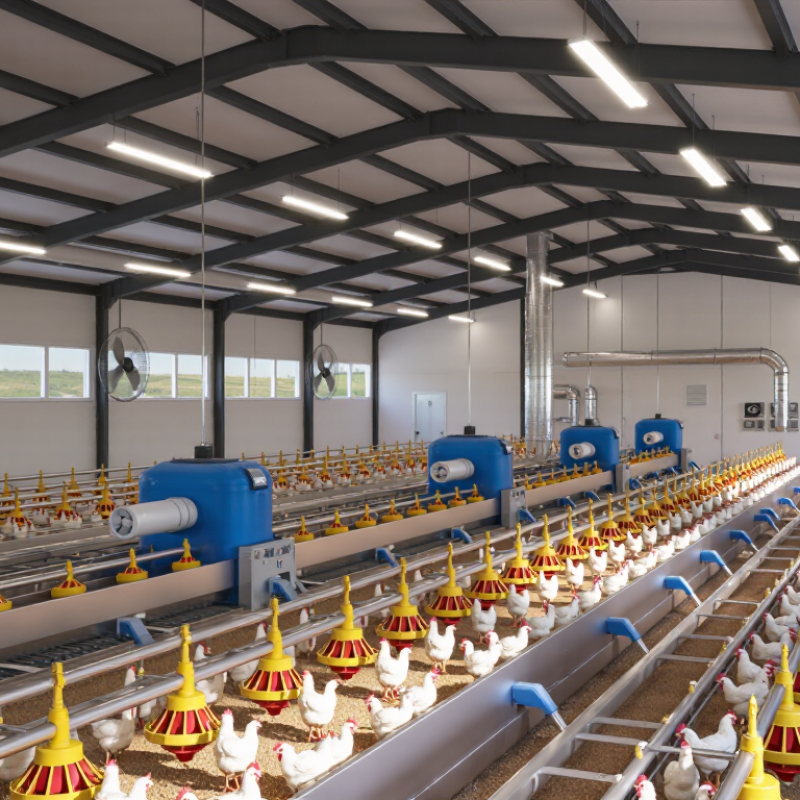
That growth increases pressure on chicken farms. Equipment suppliers now need to support reliable feeding, ventilation, watering, climate control, and manure handling. A modern broiler house may require sensors, automatic feeders, cooling pads, backup power, and alarm systems. Small failures can become expensive quickly. A hot house without airflow can damage bird welfare within hours.
The OECD-FAO Agricultural Outlook 2024-2033 expects poultry to remain a major source of future meat consumption. Buyers should compare suppliers by measurable performance, not attractive catalogs. Check energy use, spare-parts availability, installation training, and response times across different climates. Ask for test data from dusty or humid farms. Real experience matters.
Price alone can mislead.
I have seen equipment appear efficient during demonstrations but perform poorly after installation. Water pressure, house design, local voltage, and worker training can change results. Suppliers should provide clear specifications and maintenance schedules. Buyers also need realistic production targets, because USDA forecasts are not guarantees. Weather, feed costs, disease controls, and trade policies may still shift the market.
Global chicken farm equipment buying starts with the birds’ daily environment. Housing systems should provide dry litter, steady airflow, and enough space for natural movement. Experienced farm managers check galvanized frames, drainage points, door seals, and cleaning access before comparing prices. Measure twice. A weak layout can increase injuries, labor, and disease pressure.
Feeding equipment needs accurate delivery from the first hopper to the final pan. Adjustable feed lines help reduce waste when bird weight changes. Nipple drinkers should maintain suitable water pressure without leaving wet litter. During site visits, buyers should inspect motors, sensors, spare parts, and maintenance instructions. Small errors matter. A supplier may offer efficient equipment, yet poor installation support can reduce its real value.
Climate equipment controls heat, humidity, dust, and ventilation. Fans, inlets, heaters, cooling pads, and backup alarms must work as one system. I have seen farms install powerful fans without checking electrical capacity or emergency ventilation. That decision looked efficient, but it created operational risk. Processing equipment requires the same practical attention. Scalders, defeathering units, conveyors, weighing systems, and hygienic work surfaces should match local capacity and cleaning routines. Ask suppliers for test records, training plans, warranty terms, and documented food-safety guidance. No setup is perfect. Regular inspections remain necessary, especially after seasonal changes or production expansion.
Chicken Farm Equipment Categories: Housing, Feeding, Climate, and Processing
The chart groups commonly specified commercial poultry equipment into four purchasing categories. The values represent the number of representative equipment systems in a practical buyer checklist, including housing structures, feed delivery, environmental control, and primary processing.
Choosing chicken farm equipment starts with the production stage, not the supplier catalogue. Each system should match bird age, stocking density, climate, labor skills, and future expansion plans. In practical farm assessments, poor ventilation sizing often causes more trouble than the initial equipment cost.
Broiler houses need reliable feeding lines, drinker systems, cooling pads, heaters, and tunnel ventilation. Feed pans should distribute feed evenly, while nipple drinkers must maintain stable water pressure. Layers require stronger housing structures, nest boxes, egg collection, manure removal, and carefully controlled lighting. Small design errors can increase cracked eggs or uneven flock performance. That part is often underestimated.
Breeder farms need separate male and female feeding control, secure nest access, and accurate weighing equipment. Uniform body weight matters greatly for fertility and flock management. Hatcheries require incubators, hatchers, egg handling tables, chick processing areas, and strict temperature monitoring. Sensors should be easy to calibrate and clean. They are not maintenance-free, despite what some sales materials imply.
Global buyers should request performance data, spare-parts availability, installation guidance, and operator training. Ask how equipment performs under local humidity, dust, voltage, and water conditions. A system that works well in one region may fail elsewhere. Reviewing service records with an independent poultry engineer can expose weak assumptions before purchase. Erotiske
Modern broiler operations often target a feed conversion ratio between 1.6 and 1.8. This means birds need 1.6–1.8 kilograms of feed for one kilogram of live weight gain. The target is useful, but it is not a promise. Genetics, temperature, mortality, feed quality, and weighing methods can shift results quickly.
Efficient equipment supports this range through accurate feeding and stable house conditions. Feed lines should deliver similar portions from the first pan to the last. Sensors must detect empty lines before birds lose feeding time. Ventilation systems should remove moisture without creating cold drafts. A small wet patch near a drinker can increase litter problems and reduce daily gains. During commissioning, buyers should check feed delivery, water pressure, fan output, and alarm response under real farm conditions.
Reliable suppliers provide calibration records, maintenance instructions, and measurable performance data. Ask how feed conversion is calculated, including mortality and feed waste. A clean spreadsheet can still hide poor weighing practices. Field audits sometimes find blocked pans, leaking nipples, or uneven bird access. These details matter more than impressive catalog figures. A realistic supplier will discuss limits, spare parts, training, and local service capacity. The 1.6–1.8 target may remain difficult during heat stress or early flock imbalance. That is worth admitting. Supplier comparisons should therefore include energy use, downtime, adjustment range, and the equipment’s effect on daily flock uniformity.
| Equipment System | Key Buying Dimension | Practical Benchmark | Efficiency or Welfare Impact | Global Buyer Specification Check |
|---|---|---|---|---|
| Feed Delivery | Broiler feed conversion ratio (FCR) | 1.60–1.80 kg feed per kg live weight under well-managed commercial conditions | Lower FCR reduces feed cost and nutrient waste; results vary with genetics, climate, health, feed quality, and slaughter age | Request FCR reporting method, target live weight, mortality adjustment, and flock age at measurement |
| Pan Feeding | Birds per feed pan | Approximately 45–60 broilers per pan, depending on pan design and bird size | Adequate access supports uniform growth and helps reduce competition and uneven body weight | Confirm pan diameter, usable feeding circumference, adjustment range, and clean-out capability |
| Feed Lines | Feed distribution uniformity | Aim for approximately 90% or higher uniformity across feed pans after line adjustment | More consistent feed availability improves flock uniformity and limits selective feeding | Evaluate auger capacity, anti-bridging design, line length limits, and calibration procedure |
| Drinking System | Nipple drinker capacity | Usually about 10–15 birds per nipple, subject to local welfare rules, nipple type, and house conditions | Sufficient access supports hydration, feed intake, growth, and litter quality | Check pressure regulators, height adjustment, flow testing, water filtration, and leak alarms |
| Water Management | Water-to-feed consumption ratio | Approximately 1.6–2.0 litres of water per kg of feed in moderate conditions; heat can increase demand | Unexpected changes can indicate heat stress, leakage, disease, or feed and water-system problems | Require water meters, remote alerts, flush points, and easily sanitized contact surfaces |
| Tunnel Ventilation | Air speed at bird level | Approximately 2.0–3.0 m/s during hot-weather tunnel ventilation, adjusted for bird age and temperature | Improves wind-chill cooling and helps control heat stress when correctly designed and maintained | Verify fan capacity, static-pressure performance, inlet design, emergency ventilation, and backup power |
| House Climate Control | Relative humidity | Generally maintain about 50–70% relative humidity after the brooding period where practical | Balanced humidity supports respiratory comfort and litter quality; excessive humidity increases wet-litter risk | Check sensor accuracy, sensor placement, controller calibration, and alarm history |
| Brooding Equipment | Brooding temperature at chick level | Approximately 32–35°C during placement, then gradually reduced according to chick behavior and house conditions | Correct early temperature supports feed and water intake, leg health, and early growth | Assess heating uniformity, fuel safety, ignition reliability, zoning, and low-temperature alarms |
| Lighting | Light intensity and dark period | Use a controlled lighting program with a daily dark period; intensity is commonly reduced after brooding while maintaining bird access to feed and water | Supports rest, activity balance, welfare, and consistent feeding behavior | Confirm dimming range, light uniformity, flicker performance, timer accuracy, and emergency lighting |
| Litter and Floor Management | Litter moisture | Target dry, friable litter; approximately 20–25% moisture is often used as a practical management range | Dry litter helps reduce footpad damage, ammonia generation, and pathogen pressure | Review drinker leak prevention, ventilation control, floor drainage, and litter-depth compatibility |
| Automation and Monitoring | Critical alarm response | Continuous monitoring of temperature, humidity, ventilation status, water use, feed use, and power supply | Early alerts can reduce losses caused by equipment failure, heat stress, or water interruption | Confirm local connectivity, offline operation, data export, alarm escalation, and manual override functions |
| Energy and Backup | Power continuity | Provide automatic backup generation and tested emergency ventilation for climate-controlled houses | Maintains life-support systems during grid outages, particularly in hot or cold weather | Request load calculations, automatic transfer-switch details, fuel autonomy, preventive-maintenance plan, and test records |
Choosing poultry equipment for global farms requires more than comparing catalog prices. The USDA Foreign Agricultural Service’s April 2025 report projects global broiler production at roughly 105 million metric tons in 2025. That scale increases pressure on uptime, labor control, and consistent flock conditions. Evaluate automation through practical tests: sensor accuracy, alarm logic, data export, manual override, and cleaning access. Smart screens look impressive. They can still fail.
Certifications deserve close inspection. Ask whether ISO 9001 covers the manufacturing site, and whether electrical approvals match the installation country. The ISO Survey shows ISO 9001 remains the world’s most widely adopted quality-management certification, but certification alone does not prove reliable equipment. Request test records, material specifications, installation manuals, and traceable component lists. Independent inspection is useful. It may feel slow.
Service quality often separates a workable system from an expensive outage. Require written response times, local technicians, spare-parts availability, remote diagnostics, and commissioning support. A supplier should explain who pays for travel, software updates, and operator training. The International Energy Agency reports that electric motor systems consume about half of global electricity, making fan and pump efficiency financially important. Compare energy use under realistic flock and climate conditions, not brochure settings. Calculate total cost over ten years, including freight, water, electricity, maintenance, downtime, upgrades, and disposal. A cheaper quotation can become the costliest choice.
Contact
KYOCERA SGS Precision Tools, Inc.
(330) 686-5700
150 Marc Drive
Cuyahoga Falls, OH 44223
Products
Resources