
Choosing the right Drill Pipe manufacturer can influence drilling speed, safety, maintenance costs, and project continuity. Global buyers need more than a polished website or a long product list. They need evidence of material quality, manufacturing control, thread accuracy, and field performance.
This guide examines ten manufacturers serving international drilling markets. It considers product range, steel grades, connection options, heat treatment, inspection procedures, and export capability. Practical details matter. A reliable supplier should explain wall thickness, tool joint dimensions, torque limits, and applicable technical standards. Inspection records should be clear, traceable, and available before shipment. Small details often reveal larger strengths.
Field experience also deserves attention. A pipe that performs well in a controlled test may face different conditions in hard rock, deep wells, or corrosive formations. Supplier communication, replacement support, and delivery consistency can become decisive after the purchase order is signed. They matter greatly.
The manufacturers discussed here represent different strengths, capacities, and market positions. Some focus on large-volume production, while others provide specialized connections or customized specifications. No ranking can fit every drilling program. That is worth remembering. Buyer priorities change by region, rig design, formation, budget, and service expectations. A reasonable comparison must therefore balance technical evidence with practical experience, not marketing claims alone. Product data can also change over time, so buyers should verify current certifications, factory capabilities, and contract terms directly with each manufacturer before making a final decision.
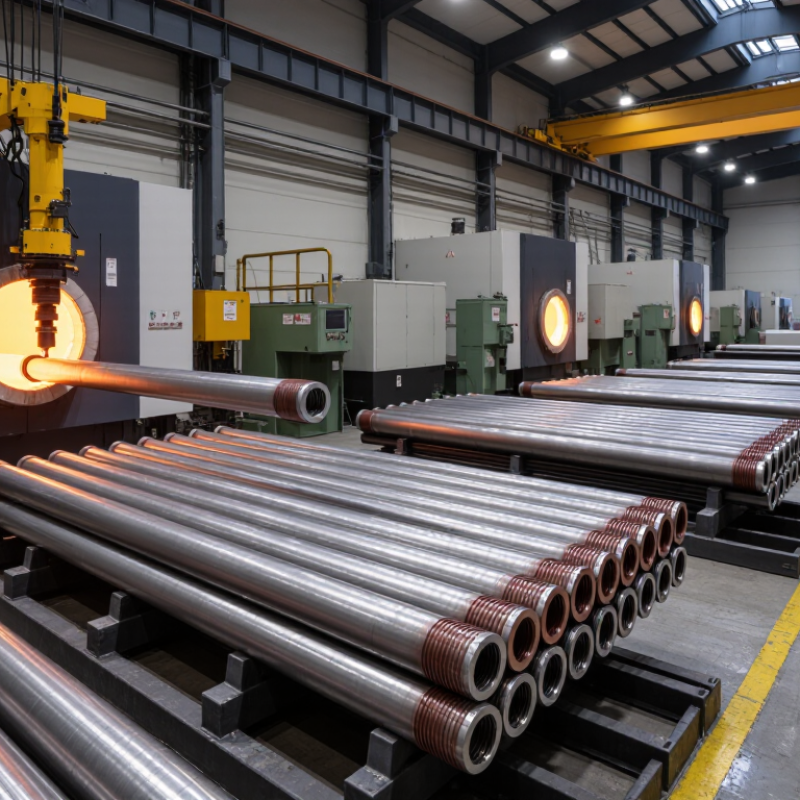
Drill pipe is the working link between a surface rig and the bottom-hole assembly. It transfers rotation and weight while carrying drilling fluid to the bit. Each joint must tolerate repeated bending, vibration, pressure, and make-up torque. Small defects can become serious failures underground. That is why experienced buyers examine steel grade, wall thickness, connection design, hardbanding, and non-destructive testing records. Thread protectors also matter during transport and storage. They prevent damage before the pipe reaches the rig.
For global drilling operations, drill pipe must suit the well, rig, fluid system, and local logistics. A deep directional well may require higher torsional strength and tighter inspection controls. A remote land project may prioritize repair support, spare joints, and traceable delivery documents. Buyers comparing manufacturers should request heat numbers, inspection reports, dimensional records, and evidence of quality-system control. Recognized industry standards help, but paperwork alone is not enough. A clean certificate cannot reveal every handling mistake. Field feedback remains valuable. In practice, pipe performance often depends on storage, cleaning, torque management, and crew discipline. This is easy to underestimate. I would also question unusually low prices, because reduced inspection or inconsistent metallurgy may appear only after deployment. Careful supplier audits, sample reviews, and clear acceptance criteria create a more reliable purchasing decision.

When comparing the top 10 drill pipe manufacturers, buyers should examine evidence, not polished catalogs. API Specification 5DP defines requirements for drill pipe dimensions, materials, testing, and marking. A credible supplier should provide heat numbers, inspection records, connection data, and fatigue-test results for every production batch.
Material discipline matters. The World Steel Association reported global crude steel production of about 1.89 billion tonnes in 2023. Large output does not guarantee suitable pipe quality. Ask how steel chemistry, heat treatment, tool-joint welding, and non-destructive testing are controlled. Field experience also matters. Review failure histories, repair rates, delivery performance, and technical support in similar formations. ISO 13679 testing principles can help buyers assess connection sealing and mechanical reliability, although laboratory results cannot fully reproduce harsh downhole conditions.
Tips: Request three recent inspection files. Compare actual data, not promises. Check whether warranties cover fatigue and connection damage. The IEA’s Oil 2024 report expects global oil demand to approach a plateau by 2030, increasing pressure to control lifecycle costs. Therefore, price per joint is a weak measure. Consider service life, inspection intervals, transport losses, and availability near the drilling region. A supplier with excellent paperwork may still perform poorly in remote operations. That risk deserves direct customer references and a practical trial order. Perfect scoring is unlikely; buyers should document the compromises.
The chart presents a practical 100-point procurement weighting model for comparing drill pipe suppliers. It focuses on verifiable product, quality, compliance, and supply-chain factors rather than company or brand performance.
Evaluation criteria are aligned with commonly used industry references, including API Specification 5DP, ISO 11960, ISO 10424-1, documented non-destructive testing, dimensional inspection, material traceability, and connection compatibility. Weightings are an illustrative buyer benchmark and should be adjusted for each drilling application.
Top 10 Drill Pipe Manufacturers for Global Buyers
The strongest drill pipe manufacturers compete through measurable product strengths, not attractive catalogs. Their leading advantages include high-strength steel grades, accurate tool-joint machining, and consistent friction welding. API Specification 5DP remains a practical baseline for dimensions, materials, and inspection. However, certification alone does not guarantee field performance.
The top ten suppliers usually separate themselves in several areas. Some specialize in premium connections that reduce torque and pressure losses. Others focus on hardbanding, sour-service resistance, or lightweight pipe for extended-reach wells. Reliable manufacturers also provide full heat-treatment records, ultrasonic inspection, and traceable mill certificates. A pipe arriving with clean threads and protective caps matters on a muddy rig floor. Small details become expensive quickly.
IEA’s Oil 2024 report forecasts oil demand reaching 105.4 million barrels per day by 2029, increasing pressure on drilling efficiency. That outlook supports continued demand for durable tubular products, but buyers should remain careful. A high tensile rating may hide poor fatigue resistance or inconsistent connection makeup. My practical preference is simple: compare inspection data, repair history, delivery reliability, and independent test results. A perfect ranking is impossible. Regional service capacity can outweigh a stronger brochure specification. One weakness remains common across the market: buyers sometimes compare price before reviewing lifecycle cost.
A credible top-ten shortlist should compare more than factory capacity. Buyers need consistent steel chemistry, accurate tool-joint machining, and reliable heat treatment. These details affect torque, fatigue life, and connection performance underground. Manufacturers following API 5DP and ISO-based quality systems usually offer clearer inspection records. Still, certification alone does not guarantee field performance. Ask for mill certificates, dimensional reports, and recent third-party inspection results.
Pricing varies with steel grade, pipe size, connection type, coating, and order volume. The lowest quotation may exclude inspection, protective packaging, or ocean freight preparation. Lead time also matters. A supplier with regional stock can reduce project delays, while a large factory may provide better pricing for scheduled production. Global buyers should examine export experience, documentation accuracy, spare-part support, and communication across time zones. Small errors become expensive quickly.
Tips: Request a sample quality dossier before signing. Compare total landed cost, not only unit price. Check thread protection on arrival, then record surface marks, drift results, and dimensional deviations. Speak with a recent customer if possible. Be cautious with impressive claims that lack traceable evidence. A practical comparison may feel slower, but it exposes weak assumptions. That is often where savings begin.
Top 10 Drill Pipe Manufacturers for Global Buyers
How Global Buyers Can Select the Right Drill Pipe Supplier
Choosing a drill pipe supplier requires more than comparing catalog prices. Buyers should match pipe grade, size, wall thickness, tool joint design, and connection type with the drilling program. A supplier should provide clear technical data, including yield strength, tensile strength, weight, and dimensional tolerances. Small differences matter underground. They can affect torque, fatigue life, and connection performance.
Ask for material certificates and full heat-number traceability. Reliable suppliers support independent inspections, ultrasonic testing, drift checks, and visual examination. Their products should follow recognized requirements, such as API Spec 5DP, when applicable. For demanding wells, verify hardbanding quality and resistance to galling. Sour-service operations need additional material controls and documented testing. Do not accept vague claims.
Delivery experience also deserves careful review. Confirm production capacity, packing methods, replacement procedures, and technical support across borders. Request references from projects using similar depths and formations. A low quotation may hide longer lead times or weaker inspection control. That mistake becomes expensive. No supplier is perfect, and even strong documentation cannot replace practical communication during a failure. Buyers should test response speed before placing a large order. They should also review warranty limits, inspection records, and change-control procedures. The best choice balances engineering confidence, verified quality, and dependable service.
| No. | Anonymous Supplier Profile | Relevant Product Standard | Common Steel Grades | Typical Drill Pipe Outside Diameters | Common Range of Pipe Lengths | Tool Joint Options | Connection Selection | Quality and Inspection Evidence to Request | Best-Fit Application |
|---|---|---|---|---|---|---|---|---|---|
| 1 | Integrated API-certified manufacturer | API Spec 5DP; dimensional and performance requirements should be confirmed against the purchase specification. | E-75, X-95, G-105, S-135 | 2⅜ in, 2⅞ in, 3½ in, 4 in, 4½ in, 5 in, 5½ in, 6⅝ in | Range 1: 18–22 ft; Range 2: 27–31 ft; Range 3: 38–45 ft | Integral or separate tool joints; NC, REG, FH and other specified connections | Match connection type, torque capacity and bore with the drilling-string design. | Current API certificate, heat-number traceability, mill certificates, dimensional reports and third-party inspection records | Large-volume land and offshore drilling programs requiring consistent production. |
| 2 | High-strength drill pipe specialist | API Spec 5DP with project-specific requirements for high-strength grades. | G-105 and S-135; higher-strength options require engineering validation. | 3½ in, 4 in, 4½ in, 5 in, 5½ in | Most commonly Range 2 and Range 3 | Heavy-duty tool joints with hardbanding options | Verify yield strength, tensile strength, fatigue performance and tool-joint design. | Heat treatment records, hardness mapping, ultrasonic testing, magnetic-particle inspection and hardbanding procedure | Deep, extended-reach and high-torque drilling where tensile capacity is critical. |
| 3 | Offshore drilling-string supplier | API Spec 5DP plus offshore project specifications and relevant inspection practices. | E-75, X-95, G-105, S-135 | 4 in, 4½ in, 5 in, 5½ in | Range 2 and Range 3 are widely used offshore. | NC50, 6⅝ REG, FH and other customer-specified tool-joint connections | Assess buoyancy, fatigue life, corrosion allowance and compatibility with the rig's handling system. | Full traceability, fatigue or stress analysis where required, coating records and independent inspection reports | Offshore, harsh-environment and long-duration drilling campaigns. |
| 4 | Directional and horizontal drilling supplier | API Spec 5DP with directional-drilling requirements defined by the operator. | G-105 and S-135; grade selection depends on torque and fatigue calculations. | 2⅞ in, 3½ in, 4 in, 4½ in, 5 in | Range 2 and Range 3 | NC38, NC40, NC46, NC50 and other compatible connections | Review torsional strength, bending stress, connection make-up torque and tool-joint wear resistance. | Connection gauging, torque-turn records, drift data, straightness reports and non-destructive examination | Horizontal wells, extended-reach wells and rotary steerable drilling. |
| 5 | Sour-service capable supplier | API Spec 5DP supplemented by the purchaser's sour-service requirements. | Compatible grades must be qualified for the specified hydrogen-sulfide environment; do not assume every grade is suitable. | 3½ in, 4 in, 4½ in, 5 in | Range 2 and Range 3 | Connection and hardbanding system selected to limit stress concentration and corrosion risk | Confirm compliance with the operator's H₂S, hardness, metallurgy and corrosion-control requirements. | Material qualification, hardness testing, sulfide-stress-cracking evaluation and documented corrosion-control procedures | Wells containing hydrogen sulfide or other corrosive formation fluids. |
| 6 | Premium connection-focused manufacturer | API Spec 5DP and the specific premium-connection manufacturer's licensed requirements. | E-75, X-95, G-105, S-135, subject to connection qualification | 2⅞ in, 3½ in, 4 in, 4½ in, 5 in, 5½ in | Range 2 and Range 3 | API or proprietary premium connections; compatibility must be confirmed before ordering. | Check tensile efficiency, compression rating, seal design, torque range and interchangeability. | Connection qualification reports, thread inspection, phosphate or coating records and make-up documentation | High-angle wells and projects requiring improved sealing or fatigue performance. |
| 7 | Small-diameter and workover supplier | API Spec 5DP where applicable; verify whether the product is drill pipe, tubing or workover pipe. | E-75, X-95 and selected G-105 products | 2⅜ in, 2⅞ in, 3½ in | Range 1 and Range 2 | NC26, NC31, NC38, REG and other small-diameter connections | Confirm drift diameter, tool-joint dimensions, elevator compatibility and handling limits. | Dimensional inspection, drift records, wall-thickness readings, thread inspection and individual pipe tally | Workover units, slim-hole drilling and low-to-medium torque applications. |
| 8 | Heavy-weight drill pipe and transition-section supplier | Applicable drill-stem product standards and the purchaser's heavy-weight drill pipe specification. | Commonly S-135 or project-specified grades | 3½ in, 4 in, 4½ in, 5 in, 5½ in | Range 2 and Range 3 | Integral wear pads, center upset or spiral-grooved designs with matching connections | Verify weight per foot, body geometry, wear-pad dimensions and transition-zone design. | Weight and dimensional reports, ultrasonic inspection, weld or upset qualification and wear-pad inspection | Transition zones between drill collars and conventional drill pipe. |
| 9 | Rental-fleet and reconditioning specialist | Original product standard plus a documented inspection and reconditioning program. | E-75, X-95, G-105 and S-135, depending on available inventory | 2⅞ in, 3½ in, 4 in, 4½ in, 5 in | Range 1, Range 2 and Range 3 | Existing API or premium connections; inspect before compatibility approval. | Review remaining wall thickness, connection condition, fatigue history, hardbanding condition and repair status. | Recent inspection date, serial-number history, drift report, EMI or MPI report, ultrasonic wall-thickness report and repair records | Short-term projects, contingency inventory and cost-sensitive drilling programs. |
| 10 | Export-oriented customized supplier | API Spec 5DP or an equivalent agreed specification, subject to destination-country requirements. | E-75, X-95, G-105, S-135 and other grades approved by the project engineer | 2⅜ in through 6⅝ in, subject to manufacturing capability and order quantity | Range 1, Range 2 and Range 3 | API, REG, FH, NC and customer-specified connections | Confirm customs documents, packaging, marking, spare-part availability, lead time and after-sales support. | Certificate of conformity, packing list, material certificates, inspection release note, serial-number list and export packaging records | International buyers needing customized dimensions, mixed sizes or consolidated shipments. |
| Buyer note: API Spec 5DP identifies requirements for drill pipe, but the final purchase decision should also consider grade, size, range, connection, tool-joint dimensions, inspection level, service environment, traceability, delivery capability and compatibility with the existing drilling string. Supplier profiles above are anonymous selection categories rather than a ranking of named companies. | |||||||||
Contact
KYOCERA SGS Precision Tools, Inc.
(330) 686-5700
150 Marc Drive
Cuyahoga Falls, OH 44223
Products
Resources