Top 304 Stainless Steel Cookware Manufacturers Worldwide
Choosing among the top 304 Stainless Steel Cookware manufacturers worldwide requires more than comparing polished catalogs. Buyers should examine material specifications, production experience, testing records, and after-sales support. Reliable manufacturers usually provide clear steel grades, dimensional drawings, surface-finish options, and batch traceability. Their cookware should feel balanced in the hand, with smooth rims, secure handles, and clean welds around the base.
This guide evaluates manufacturers through practical and professional criteria. These include factory capacity, quality-control systems, export experience, customization services, and independent certifications where available. A serious supplier should explain how it checks thickness, flatness, corrosion resistance, and cookware performance. Small details matter. A loose lid, uneven polishing, or warped bottom can damage an otherwise strong product.
The ranking remains a useful starting point, not a permanent verdict. Manufacturing quality can change after new equipment, management changes, or supplier substitutions. Some companies also present impressive claims that deserve closer verification. That is why this overview considers evidence from factory information, product documentation, customer feedback, and industry reputation. Regional strengths may differ, too. One manufacturer may excel at large-volume hotel cookware, while another may deliver better small-batch designs or complex induction bases. Readers should compare samples before signing a long-term agreement. Even trusted suppliers can make occasional mistakes. Careful inspection still matters.
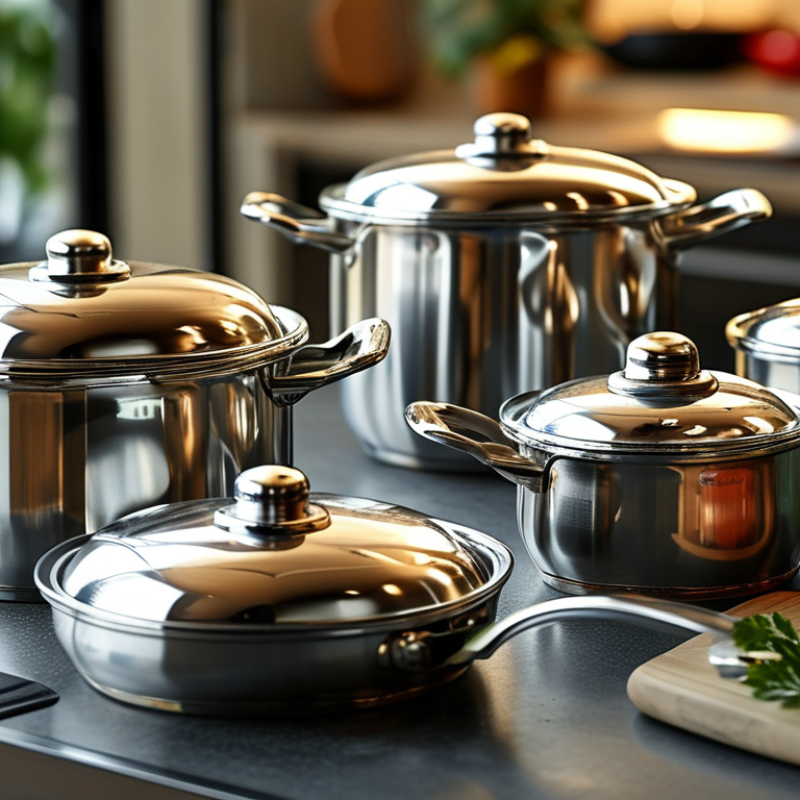
304 Stainless Steel Explained: 18–20% Chromium and 8–10.5% Nickel
304 stainless steel is widely used in cookware because its chemistry supports durability and food-contact performance. It typically contains 18–20% chromium and 8–10.5% nickel. Chromium forms a thin protective oxide layer on the surface. Nickel improves corrosion resistance and helps maintain a stable structure.
That balance matters in daily cooking. Tomato sauce, salt, steam, and repeated washing can challenge metal surfaces. In cookware production, manufacturers usually shape 304 steel through pressing, spinning, or deep drawing. A pot with consistent thickness heats more predictably and resists distortion. However, 304 steel alone does not guarantee excellent cooking performance. The base design, welding quality, handle attachment, and surface finishing also require attention.
Composition is only one checkpoint. Quality teams may verify the alloy with handheld material analyzers, thickness gauges, and visual inspections. These checks can reveal mixed materials, weak welds, or uneven polishing. A glossy surface is not proof of superior steel. I once assumed that heavier cookware always indicated better quality. That assumption was incomplete. Weight may come from a thick base, not the entire body. Even reliable specifications need practical verification. Buyers should request material certificates and inspect the cooking surface for pits, sharp edges, or discoloration. Small manufacturing variations still matter.
How Manufacturers Meet ASTM A240 and Food-Contact Safety Standards
Top 304 Stainless Steel Cookware Manufacturers Worldwide
Reliable manufacturers treat ASTM A240/A240M as a material baseline, not a complete safety certificate. The standard controls chromium-nickel stainless steel sheet, including chemical composition, mechanical properties, dimensions, and surface quality. For 304 cookware, factories verify heat numbers through mill certificates and use positive material identification on incoming coils. Small suppliers sometimes skip this step. That weakness deserves attention.
Food-contact compliance requires more than the “304” label. Under the U.S. FDA Food Code 2022, food-contact equipment should be corrosion-resistant, smooth, and cleanable. Manufacturers therefore control weld geometry, remove burrs, and passivate heat-tinted areas. Many also test surface migration, detergents, and repeated heating cycles. NSF/ANSI 51 provides another practical benchmark for food-equipment materials and finishes.
The European Commission’s Regulation (EC) No. 1935/2004 requires food-contact materials to avoid transferring harmful substances or changing food composition. Strong factories keep batch records, supplier declarations, and traceable test results. They inspect rivets, handles, and rolled edges, where residue can hide. A polished surface can still fail after poor welding. That is the uncomfortable detail. Audit frequency, test scope, and documentation quality often separate dependable production from attractive packaging.
Global Supplier Ranking by Capacity, Certifications, and Export Reach
Top 304 Stainless Steel Cookware Manufacturers Worldwide
A credible global ranking should measure more than factory size. Capacity matters, but verified production lines, monthly output, equipment age, and lead-time consistency reveal more. During supplier evaluations, buyers should inspect stamping presses, polishing areas, welding stations, and packing controls. A large facility can still deliver uneven finishes. That detail is often missed.
Certifications strengthen the assessment. ISO 9001 indicates structured quality management, while food-contact reports should match the destination market. Test documents need clear product references, laboratory details, and recent dates. Export reach also matters. Suppliers serving several regions usually understand labeling, carton specifications, customs documents, and port schedules. Yet export volume alone does not prove reliability. Some factories manage high volumes but respond slowly when defects appear. A ranking should therefore combine capacity, certification validity, shipment history, and after-sales evidence.
Tips: Request a recent production video, sample inspection record, and three shipment references. Compare promised capacity with actual monthly schedules. Ask how the supplier handles warped bases, loose handles, or scratched surfaces. Small questions matter. No ranking is perfect; data can change after seasonal orders, equipment upgrades, or management changes. Buyers should review the evidence again before signing a long-term agreement.
Top 304 Stainless Steel Cookware Manufacturers Worldwide
Global supplier benchmark by production capacity, certification coverage, and export reach
The chart uses an anonymized 0–100 benchmark index. Capacity reflects production scale, certification coverage reflects internationally recognized quality, environmental, social, and food-contact compliance systems, and export reach reflects the breadth of international markets served. No company or brand names are displayed.