
KYOCERA SGS Precision Tools Group
Package drop testing reveals how well a product survives the careless moments of real distribution. A carton may fall from a loading dock, tilt inside a truck, or strike a warehouse floor on one corner. These impacts expose weak packaging, loose components, and poorly protected edges. A reliable Package Drop Tester helps engineers reproduce those events under controlled conditions.
This guide examines the top 10 types of package drop testers used in laboratories and production environments. The list includes free-fall, guided, pneumatic, motorized, inclined-impact, and edge-drop systems. Each design creates different impact conditions. Some testers suit small boxes, while others handle heavy crates or irregular containers. Practical experience matters here. A machine can meet a specification yet still produce unhelpful results if the fixture is poorly adjusted.
Small details change the outcome. Drop height, package orientation, release speed, floor material, and sensor accuracy all deserve attention. A corner drop may reveal damage that a flat drop misses. An inclined impact can simulate sliding collisions between cartons. The best equipment supports repeatable testing, clear records, and sensible maintenance.
No test plan is flawless. Packaging also behaves differently with humidity, temperature, and repeated handling. That limitation deserves honest consideration. Results should guide improvements, not create false confidence. By comparing each tester’s structure, operating method, advantages, and practical limitations, packaging teams can select equipment with stronger technical judgment and greater reliability.
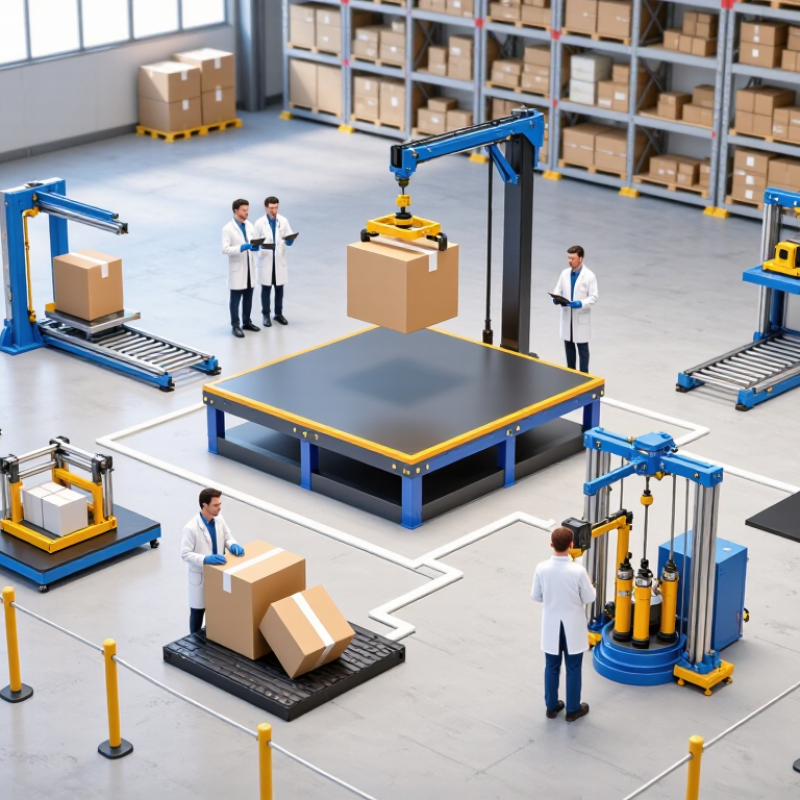
Package Drop Testing: Purpose, Principles, and Key Performance Factors
Package drop testing reveals how a shipment behaves after realistic handling shocks. The main goal is simple: protect the product, not merely the carton. Common equipment includes free-fall, guided-free-fall, rotational, corner, edge, face, inclined-impact, horizontal-impact, pneumatic, and servo-controlled drop testers. Each design creates a different impact pattern.
ASTM D5276 and ISO 2248 define controlled drop-test methods for filled transport packages. A 0.8-meter drop produces an impact speed of about 4.0 meters per second under ideal conditions. Real parcels rarely behave ideally. Orientation, package mass, floor stiffness, closure strength, cushioning, and internal movement can change the result. A rigid floor may expose weak corners quickly. A soft surface may hide them.
ISTA 3A also evaluates distribution risks through conditioning, vibration, and shock sequences. Test engineers should record drop height, impact face, acceleration, duration, and visible product damage. Sensors can reveal a brief acceleration spike that a visual inspection misses. One weakness remains: laboratory drops cannot reproduce every warehouse mistake. Repeating tests after cold, heat, or humidity conditioning improves confidence. Still, over-testing one corner can create a false sense of security. Practical experience suggests testing several orientations and reviewing failure evidence carefully. Packaging data should guide redesign, not decorate a report.
| No. | Package Drop Tester Type | Testing Principle | Primary Drop or Impact Mode | Typical Package Applications | Important Performance Factors | Commonly Referenced Methods |
|---|---|---|---|---|---|---|
| 1 | Free-Fall Drop Tester | The package is raised to a specified height and released without guided contact so that it impacts a rigid or specified surface under gravity. | FaceEdgeCorner | Corrugated shipping cases, retail cartons, small appliances, consumer goods, and e-commerce parcels. | Drop-height accuracy, release without initial push, platform rigidity, package orientation, test repeatability, and maximum package mass. | ASTM D5276 and ISO 2248 are commonly used for free-fall and vertical impact evaluation. |
| 2 | Guided Vertical Drop Tester | A carriage or lifting platform controls the vertical travel and releases the package at a repeatable height, reducing operator variation. | Vertical free fallRepeat drops | Laboratory qualification testing, standardized distribution simulations, and packages requiring consistent test sequences. | Guide-rail alignment, release timing, platform levelness, lifting capacity, impact-surface flatness, and control-system repeatability. | Often configured to meet vertical drop requirements in ASTM, ISO, and distribution-test procedures. |
| 3 | Corner, Edge, and Face Drop Tester | Fixtures or positioning devices place a package in a controlled orientation before the drop, allowing weak structural areas to be evaluated separately. | CornerEdgeFace | Regular slotted cartons, framed products, bottles in cases, and packages with defined geometric faces or corners. | Orientation precision, fixture release clearance, corner and edge identification, contact-surface condition, and sequence control. | Commonly used as an accessory configuration for ASTM D5276 or ISO 2248 test sequences. |
| 4 | Rotational Edge-Drop Tester | The package rotates around a defined edge or hinge line and is released so the selected edge or corner strikes the impact surface first. | Rotational edgeCorner impact | Cartons containing fragile products, heavy items with a high center of gravity, and packages vulnerable to edge-first impacts. | Rotation angle, hinge-axis location, release consistency, center-of-gravity effects, impact velocity, and fixture friction. | Used where a controlled edge or corner impact is required within a package-performance test plan. |
| 5 | Inclined Impact Tester | The package or sled travels down an inclined track and impacts a fixed stop, simulating sliding, conveyor, or handling collisions. | Inclined impactSliding collision | Long cartons, parcel shipments, unit loads, and packages exposed to conveyor transfers or vehicle movement. | Track angle, impact speed, carriage mass, stop-bar stiffness, package restraint, alignment, and friction conditions. | ASTM D880 is commonly associated with impact testing of shipping containers and systems on an inclined plane. |
| 6 | Horizontal Impact Tester | A package, sled, or platform is accelerated horizontally and brought to a sudden stop or driven into a rigid barrier to create a controlled shock. | Horizontal shockBarrier impact | Large cases, palletized products, transport containers, and packages subject to vehicle or handling-equipment impacts. | Impact velocity, deceleration pulse, barrier stiffness, fixture strength, package mass, and acceleration measurement. | Horizontal impact procedures may be specified in transport-packaging and shock-testing protocols, including ASTM shock methods. |
| 7 | Pallet or Unit-Load Drop Tester | A complete palletized or unitized load is lifted and released, or one end is lowered or dropped, to assess load stability and product protection. | Unit-load dropPallet edge impact | Pallet loads, stretch-wrapped cases, bulk containers, drums, and heavy industrial shipments. | Rated load capacity, lifting stability, pallet support, load restraint, drop height, center of gravity, and floor impact strength. | Selected when a distribution procedure requires evaluation of a full unit load rather than an individual carton. |
| 8 | Large-Container or Crate Drop Tester | A large case, crate, or rigid shipping container is lifted and released from a controlled height to examine structural integrity and internal protection. | Large free fallContainer impact | Wooden crates, heavy machinery packages, export cases, large equipment containers, and oversized protective packaging. | Maximum dimensions, lifting-point safety, load capacity, release synchronization, floor flatness, container deformation, and operator protection. | Configured according to the applicable shipping-container, crate, or project-specific qualification procedure. |
| 9 | Drum and Tumble Tester | The package is repeatedly rotated, tumbled, or dropped inside a drum to reproduce rough manual handling and repeated low-height impacts. | TumbleRepeated dropAbrasion | Small parcels, mailers, flexible packs, retail packages, and products likely to experience repeated handling events. | Drum dimensions, rotation speed, baffle geometry, cycle count, package size, impact frequency, and internal product restraint. | ISTA-style parcel handling procedures and other laboratory rough-handling protocols may use drum or tumble equipment. |
| 10 | Instrumented Shock Drop Tester | An accelerometer or data-acquisition system records the shock pulse generated when the package impacts a controlled surface or shock table. | Measured shockAcceleration pulse | Fragile electronics, precision instruments, medical devices, optical products, and cushioning-system development. | Sampling rate, sensor range, mounting location, peak acceleration, pulse duration, velocity change, frequency response, and calibration. | ASTM D3332 and related shock-measurement practices are commonly considered when quantifying package shock response. |