
China’s Sound Activated Light industry is moving beyond novelty products. It now serves homes, retail interiors, entertainment venues, and smart-building projects. The International Energy Agency’s Energy Efficiency 2023 report identifies lighting as roughly 15% of global electricity consumption. That figure explains the commercial interest in efficient LED systems and responsive controls.
Market research from Grand View Research and MarketsandMarkets also forecasts continued expansion in smart lighting. However, market size alone cannot identify a dependable manufacturer. Product quality depends on microphone sensitivity, signal-processing speed, LED heat management, firmware stability, and supply-chain control. A light that reacts late to a drumbeat feels defective, even when its brightness looks impressive.
This China Top 10 Sound Activated Light manufacturers overview evaluates more practical evidence. It considers factory experience, OEM and ODM capability, product testing, certification support, customization depth, and after-sales reliability. Relevant standards may include IEC 60598 safety requirements, electromagnetic compatibility testing, RoHS compliance, and market-specific certification.
Details matter.
For example, a manufacturer should explain whether its microphone detects speech, music, or only stronger bass frequencies. It should also disclose response latency, operating temperature, power ratings, and expected service life. These specifications are often missing from promotional pages. That weakness deserves attention.
The ranking is therefore not based only on online visibility or export claims. It combines publicly available company information with manufacturing indicators and buyer-focused considerations. Still, supplier data can change, and some company disclosures remain incomplete. Readers should verify samples, factory records, test reports, and warranty terms before purchasing. This approach aims to provide a useful starting point, not an unquestionable verdict.
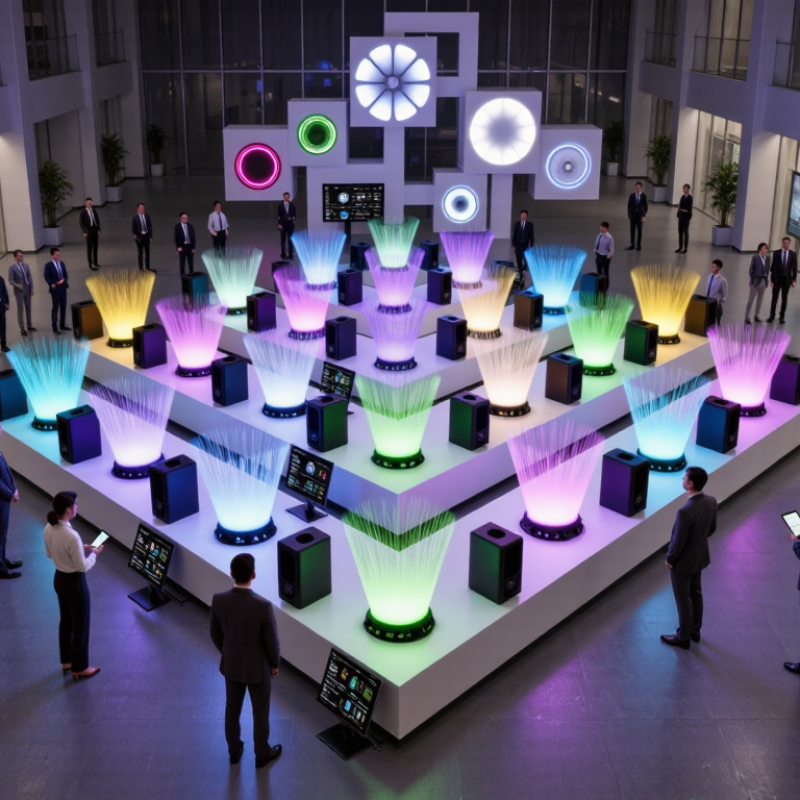
Sound-activated lights respond to changes in surrounding sound pressure. A small microphone captures claps, footsteps, music, or spoken sounds. The control circuit filters that signal and compares it with a preset sensitivity level. When the sound crosses that threshold, a relay, dimmer, or LED driver switches the light on.
The process happens quickly. In a corridor, one clap may activate a ceiling fixture for thirty seconds. In a studio, bass can create repeated triggers. That is why better products use adjustable sensitivity, delay timers, and frequency filtering. A basic microphone may react to traffic or air-conditioning noise. The design is not perfect. Room echoes can also confuse the sensor.
Energy performance depends mainly on the light source, not the microphone. The U.S. Department of Energy reports that LED lighting can use at least 75% less energy and last up to 25 times longer than incandescent lighting. This supports LED-based sound-activated systems in halls, bedrooms, and display areas. However, activation frequency still matters. A light that turns on unnecessarily wastes energy. The International Energy Agency identifies lighting as a major electricity-use area, making control systems relevant to efficiency planning. When comparing manufacturers, examine microphone range, standby power, response time, timer accuracy, and safety certifications. Real installation tests matter more than attractive specifications.

Sound-activated lights use a microphone to detect changes in sound pressure. When the measured sound exceeds a configured sensitivity threshold, an electronic controller triggers the light or changes its brightness. The chart below shows approximate A-weighted sound-pressure levels for ten common environments that may activate a sound-responsive lighting system.
Sound levels are approximate dBA values and can vary with distance, room acoustics, equipment, and measurement conditions. A sound-activated light does not respond to sound level alone; its response also depends on the microphone sensitivity and controller threshold.
China’s top 10 sound-activated light manufacturers should be selected through evidence, not website appearance. A serious review begins with factory experience, product range, and technical capability. Manufacturers should provide clear specifications for microphone sensitivity, response time, brightness, power consumption, and operating temperature. Practical testing matters.
Test each sample in a quiet room, beside a speaker, and in a busy workshop. Measure whether the light responds to a clap, voice, or sudden impact. Check delayed activation, false triggers, and uneven brightness. A reliable manufacturer should explain its circuit design and show quality-control records. Production capacity also matters. Audited facilities, traceable components, stable soldering, and repeatable assembly reduce supply risks.
Compliance documents should match the destination market and the actual product model. Ask for test reports, safety files, material information, and inspection procedures. Export experience can reveal how well a manufacturer handles packaging, labeling, and after-sales issues. Small trial orders are useful before long-term cooperation. They expose weaknesses that factory tours may hide.
No shortlist is flawless. Product samples can be unusually well prepared. Test conditions can also be too friendly. For that reason, selection should include repeated samples, independent inspection, and customer feedback from real installations. Price deserves attention, but an unusually low quotation may reflect weaker sensors, thinner wiring, or limited testing. Manufacturers that answer technical questions directly usually deserve closer consideration.
| Rank | Selection Dimension | What Is Verified | Reference Evidence or Benchmark | Suggested Weight |
|---|---|---|---|---|
| 1 | Product Safety Compliance | Electrical construction, insulation, thermal protection, wiring, and mechanical safety of the light fitting. | Testing aligned with the applicable requirements of IEC 60598-1 for luminaires. | 18% |
| 2 | Sound-Activation Performance | Microphone sensitivity, trigger consistency, false-trigger resistance, activation distance, and response time. | Documented test results should identify sound level, distance, response time, and reset behavior. | 15% |
| 3 | Lighting Performance | Measured luminous flux, color temperature, color rendering, beam distribution, and light-output consistency. | Photometric reports should state lumens, correlated color temperature, and color-rendering results. | 13% |
| 4 | Reliability and Service Life | LED lifetime claims, driver durability, thermal management, aging performance, and failure-rate control. | Reliability data should be supported by burn-in, aging, thermal, or life-test records rather than marketing claims alone. | 12% |
| 5 | Quality Management System | Incoming inspection, process control, final testing, traceability, corrective actions, and quality documentation. | A current ISO 9001 certificate and documented inspection procedures are strong indicators of process control. | 10% |
| 6 | Environmental and EMC Compliance | Restriction of hazardous substances, electromagnetic compatibility, and interference control. | Relevant documentation may include RoHS evidence and EMC testing based on applicable IEC or EN requirements. | 9% |
| 7 | Customization Capability | Ability to customize housing, power rating, color temperature, sensing logic, packaging, and installation method. | Evaluation should consider engineering support, prototype capability, tooling experience, and documented development lead times. | 8% |
| 8 | Production Capacity and Delivery | Monthly output, production flexibility, component availability, lead-time control, and on-time delivery performance. | Capacity should be verified through production records, purchase-order references, and realistic sample-to-mass-production timelines. | 6% |
| 9 | Warranty and Technical Support | Warranty terms, replacement policy, troubleshooting support, spare-parts availability, and response time. | A written warranty policy and clearly defined after-sales process should be available before purchase. | 5% |
| 10 | Commercial Value and Transparency | Total cost, minimum order quantity, payment terms, packaging efficiency, quotation clarity, and openness of technical data. | The strongest candidates provide itemized quotations, consistent specifications, sample approval records, and transparent commercial terms. | 4% |
| Total Evaluation Weight | 100% | |||
Selection note: Manufacturers should be shortlisted only after verifying certificates, test reports, product samples, factory capabilities, and commercial documentation. Certification requirements may vary according to the destination market and product application.
China’s top ten sound-activated light manufacturers should be judged by evidence, not online rankings. No authoritative report publishes a definitive national top-ten list for this narrow product category. A practical shortlist should include manufacturers with verified factories, stable export records, and documented testing. The strongest candidates usually cover sensor modules, RGB strip systems, stage fixtures, commercial lamps, outdoor units, and OEM designs. Look for acoustic response below 100 milliseconds, adjustable sensitivity, low-voltage options, and reliable heat dissipation. Ask for sample recordings and test data. Marketing claims can be vague.
Market context still matters. Grand View Research valued the global smart lighting market at about USD 15.05 billion in 2023 and forecasts strong growth through 2030. MarketsandMarkets also reports expanding demand for connected lighting controls. These figures do not measure sound activation directly, but they show why Chinese factories are adding microphones, wireless control, and programmable effects. In supplier comparisons, check ISO 9001 records, electrical safety reports, ingress protection ratings, and production capacity. Factory audits are useful. They are not perfect. Some suppliers present impressive samples but outsource core assembly, which can weaken consistency. Buyers should compare five production samples, not one, and confirm warranty terms, firmware ownership, and replacement-part availability before ranking the ten finalists.
China’s top ten sound-activated light manufacturers generally offer LED strips, pixel bars, smart bulbs, ceiling panels, and stage fixtures. Their systems convert music into changing color, brightness, and movement. Basic models use built-in microphones and preset rhythm modes. More advanced products apply digital signal processing, separating bass, vocals, and treble before triggering effects.
Manufacturers also supply RGB, RGBW, and addressable LED systems for homes, entertainment venues, retail spaces, and temporary installations. Wi-Fi, Bluetooth, DMX512, and app control are common technologies.
Some professional units include external audio inputs, adjustable sensitivity, low-latency response, and thermal protection. IP-rated housings help outdoor products resist dust and moisture, although buyers should verify the exact rating rather than trust promotional language.
Market data supports this development. MarketsandMarkets projects the smart lighting market to grow from about USD 20.5 billion in 2022 to USD 46.1 billion by 2027. The U.S. Department of Energy reports that LED lighting uses at least 75% less energy than incandescent lighting. These figures explain the shift toward connected, programmable products.
However, sound-reactive performance varies sharply. A microphone may react poorly in noisy rooms, while aggressive bass settings can create distracting flashes. In practical testing, installers should examine response delay, color consistency, heat management, and control stability. The product may look impressive, but the software still deserves skepticism.
To compare Chinese sound-activated light suppliers, begin with the product’s actual performance, not its catalog photos. Request samples from several manufacturers and test them in a quiet room, hallway, and busy workspace. Check trigger distance, microphone sensitivity, response speed, brightness, color temperature, and false activation. A light that reacts too easily may waste power. One that responds slowly feels unreliable.
Ask each supplier for clear specifications, production capacity, minimum order quantity, lead time, and quality-control procedures. Reliable manufacturers should explain how they test microphones, LED boards, batteries, and housings. Request inspection records, material details, and relevant test reports from recognized laboratories. Factory experience matters, but written evidence matters more. A polished sample can still hide inconsistent assembly. I would also ask how defects are handled after delivery, because this point is often overlooked.
Tips: Compare identical specifications. Keep the test conditions consistent. Record sound levels and response times. Check whether replacement parts are available. Confirm packaging strength with a simple drop test. Do not choose the lowest quote too quickly; cheaper components may create dimming, battery failures, or unstable activation. Video calls can show production areas, but an independent pre-shipment inspection offers stronger evidence. Small omissions in the comparison sheet may become expensive problems later.
Contact
KYOCERA SGS Precision Tools, Inc.
(330) 686-5700
150 Marc Drive
Cuyahoga Falls, OH 44223
Products
Resources