What Is Range Exhaust and How Does It Work?
A Range Exhaust is more than a metal canopy above your cooker. It is a capture-and-removal system designed to control smoke, grease, steam, heat, and cooking odors. When the fan runs, the hood draws contaminated air into filters and pushes it outdoors through ductwork, or recirculates filtered air indoors. The result depends on more than fan speed.
As ventilation expert Richard Trethewey explains, “A range hood is only as effective as the air it captures and replaces.” That principle matters in real kitchens. A wide pan can release smoke beyond a narrow hood. A long, sharply bent duct can reduce airflow. An open window may also disturb the capture zone. Small details matter.
This guide examines what Range Exhaust means and how each part works together. We will look at baffle and mesh filters, duct size, airflow ratings, makeup air, noise, and installation positioning. You may notice that a higher CFM rating does not always create better ventilation. That assumption is common, but incomplete. A powerful fan cannot compensate for poor capture or restricted ducting. Experience also reveals a practical weakness: many explanations ignore everyday cooking habits. Stir-frying, simmering, and grilling produce different loads. Cleaning schedules matter too. A neglected filter can become greasy, loud, and less effective. Understanding these limits helps homeowners, designers, and installers choose a safer, quieter, and more reliable system for the kitchen.
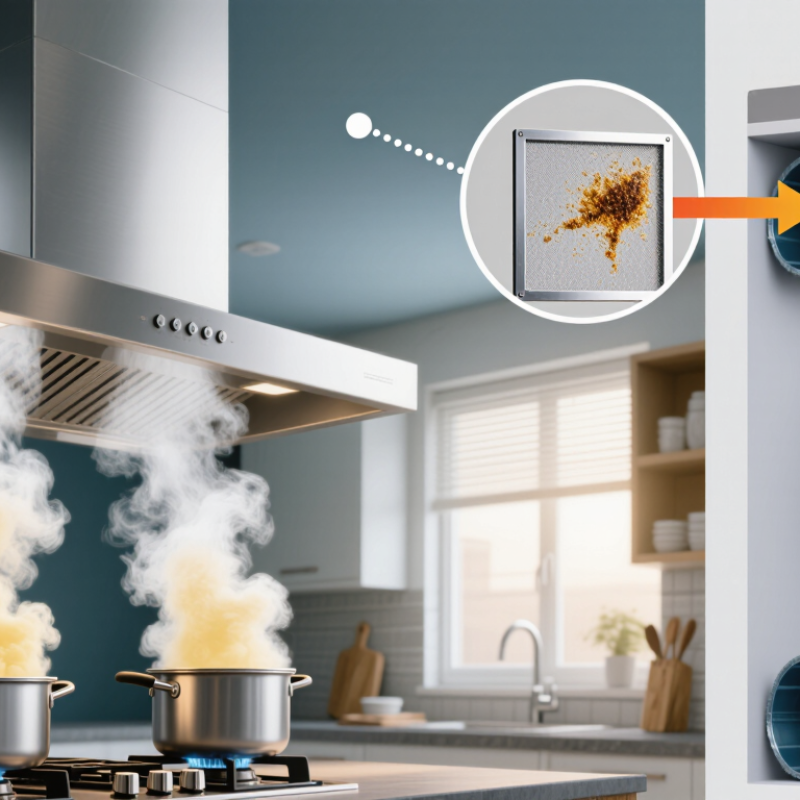
Range Exhaust Defined: Airflow, Capture, and Ventilation Standards
What Is Range Exhaust and How Does It Work?
Range exhaust is a kitchen ventilation system positioned above a cooking surface. It captures smoke, grease particles, steam, odors, and excess heat before they spread through the room. The key idea is capture and containment, not airflow alone. A powerful fan can still perform poorly if the hood is too narrow, too high, or exposed to strong cross-drafts.
Effective airflow depends on the cooking equipment, hood design, duct length, and surrounding layout. A ducted system moves contaminated air outdoors through a properly sized, sealed duct. Shorter and smoother duct routes usually reduce resistance and noise. Recirculating systems pass air through filters, but they do not remove moisture or heat from the home. That limitation is easy to overlook.
Ventilation design should follow applicable building codes and recognized residential ventilation guidance. Combustion appliances also require careful assessment, because strong exhaust can create negative pressure and affect indoor air safety. A qualified professional can check airflow, duct pressure, makeup air, and capture performance after installation. The first design estimate is rarely perfect. Real cooking conditions may reveal weak capture near the front burners or corners. A simple smoke test can expose these problems, although it should support—not replace—professional measurement and code review.
How Range Hoods Capture Smoke at 100–150 CFM per Linear Foot
What Is Range Exhaust and How Does It Work?
How Range Hoods Capture Smoke at 100–150 CFM per Linear Foot
Range exhaust removes smoke, grease, heat, and cooking odors before they spread through a room. A hood uses a fan to pull contaminated air through filters, then sends it outdoors through ductwork. In practical installations, the hood should extend across the cooking surface and sit at the correct height. Small gaps can let smoke escape.
A common sizing guide recommends 100–150 CFM per linear foot of hood width. For a 36-inch hood, that equals roughly 300–450 CFM. This is only a starting point. A powerful burner, frequent frying, or a shallow hood may require more airflow. A deeper hood can capture rising smoke more effectively, even at a lower setting.
Capture matters more than fan speed alone. When steam rises from a hot pan, the hood must create enough suction to guide it into the filters. Smooth, short duct runs usually support better performance. Sharp bends and undersized ducts can create noise and reduce airflow. I have seen hoods rated highly on paper perform poorly after difficult installation. That rule is useful, but it is not perfect.
Outdoor exhaust can also affect indoor pressure. In tightly sealed homes, replacement air may be necessary. Local mechanical requirements should be checked before installation. A quieter fan is not always weaker, and a stronger fan is not always better. Good design balances airflow, capture area, duct layout, and everyday cooking habits.
Grease Filters Explained: Aluminum Mesh, Baffle, and Charcoal Ratings
A range exhaust captures smoke, moisture, and airborne grease above a cooktop. Its fan pulls contaminated air through filters before venting it outdoors or recirculating it indoors. The filter choice affects cleaning effort, airflow, and odor control.
Aluminum mesh filters use several thin, layered screens. They are light and commonly dishwasher-safe, although harsh cycles can darken or bend the metal. Their small openings trap grease reasonably well, but buildup can restrict airflow quickly.
Clean one when grease feels sticky, not only when the fan sounds strained.
That detail is easy to miss.
Baffle filters use fixed metal panels that redirect grease into collection channels.
They handle heavy frying better and usually wipe clean more easily than fine mesh. A baffle filter is not a magic shield.
Charcoal filters serve recirculating hoods by absorbing odors after grease filtration. They do not replace grease filters, and their carbon capacity declines over time.
Charcoal ratings are not always comparable between products. Check the stated replacement interval, filter size, and airflow compatibility.
A filter may still look clean while working poorly. That is frustrating. Cooking habits matter, especially frequent frying. I would verify the manual before washing any filter, because some charcoal media cannot be cleaned.
Ductwork and Exhaust Paths: 6-Inch Minimums and CFM Loss Factors
What Is Range Exhaust and How Does It Work?
Range exhaust removes smoke, steam, grease, and cooking odors through a fan and duct system. The duct carries contaminated air outdoors, not into an attic or cabinet. A six-inch duct is commonly treated as a practical minimum for many residential range exhaust systems. However, diameter alone does not guarantee strong airflow. A short, smooth, straight duct usually performs better than a narrow path with several bends.
Airflow is measured in cubic feet per minute, or CFM. Every restriction can reduce the CFM reaching the exterior. Long duct runs create resistance. Sharp elbows, crushed flexible duct, tight transitions, dirty filters, and restrictive wall caps create more loss. Even a carefully selected fan may feel weak when the exhaust path is poorly planned. Field inspections often reveal this problem: the hood works, but the ductwork quietly limits it. The six-inch rule helps, yet it is not a complete design.
Tips: Keep the duct as short and straight as possible. Use smooth metal ductwork where practical. Seal joints carefully, and avoid unnecessary elbows. Check the exterior cap for a free-moving damper. Local requirements may differ, so confirm sizing with a qualified professional. Measure performance after installation if possible. Small oversights matter. A design can look acceptable on paper and still disappoint during heavy cooking.
What Is Range Exhaust and How Does It Work? - Ductwork and Exhaust Paths: 6-Inch Minimums and CFM Loss Factors
Range exhaust systems capture cooking smoke, grease, heat, moisture, and odors and discharge them outdoors through a dedicated duct path. The figures below are planning references based on round-duct area and air velocity; actual performance depends on the hood, fan curve, fittings, duct material, termination, and local requirements.
Round Duct Capacity Reference
| Inside Diameter | Cross-Sectional Area | Approx. Airflow at 500 fpm | Approx. Airflow at 700 fpm | Approx. Airflow at 1,000 fpm | Planning Use |
| 6 in. round | 0.196 ft² | 98 CFM | 137 CFM | 196 CFM | Common minimum baseline for smaller exhaust systems; verify the hood requirements. |
| 7 in. round | 0.267 ft² | 134 CFM | 187 CFM | 267 CFM | Provides more area than 6 inches while maintaining moderate air velocity. |
| 8 in. round | 0.349 ft² | 175 CFM | 244 CFM | 349 CFM | Often selected for medium-duty residential range exhaust applications. |
| 10 in. round | 0.545 ft² | 273 CFM | 382 CFM | 545 CFM | Suitable for higher airflow when the fan and hood are designed for the larger duct. |
| 12 in. round | 0.785 ft² | 393 CFM | 550 CFM | 785 CFM | Used for large airflow requirements or long, resistance-heavy exhaust paths. |
Calculation basis: Airflow equals duct area multiplied by air velocity. The values are theoretical airflow capacities, not guaranteed hood ratings. A 6-inch duct should not be used automatically for every hood; the specified duct diameter and maximum equivalent duct length should control the design.
Exhaust Path Components and Typical CFM Loss Factors
| Exhaust Path Condition | Typical Effect on Delivered Airflow | Why It Reduces Performance | Recommended Design Response |
| Straight, smooth rigid duct | Lowest resistance; baseline condition | Wall friction increases with length and air velocity. | Use the shortest practical route with the fewest seams. |
| Each sharp 90-degree elbow | Approximately 5–15% planning loss | The turn creates turbulence and additional pressure loss. | Use long-radius elbows where space permits and minimize direction changes. |
| Long or compressed flexible duct | Approximately 10–25% additional loss | Ridges, sagging, compression, and smaller effective area increase friction. | Prefer smooth, rigid metal duct and keep any flexible section short and fully extended. |
| Diameter-reducing transition | Approximately 5–15% additional loss | The smaller section raises air velocity and pressure resistance. | Avoid reductions; use a gradual transition when one is unavoidable. |
| Backdraft damper or exterior wall cap | Approximately 5–15% additional loss | Blades, screens, louvers, and weather protection restrict the outlet. | Select a properly sized, low-resistance termination and keep it clean. |
| Long duct run | Approximately 10–30% or more, depending on length | Cumulative wall friction grows as the equivalent length increases. | Increase duct size when appropriate and verify the fan’s static-pressure capability. |
| Grease, dust, or blocked termination | Variable; may cause a major reduction | Accumulated residue narrows the passage and increases resistance. | Inspect and clean the hood filters, duct access points, damper, and exterior cap. |
Important design note: The percentage ranges above are general planning estimates and should not be added together as exact values. Duct losses are normally evaluated using equivalent length, fitting resistance, and the fan’s available static pressure. Always follow the applicable building and mechanical codes and the exhaust hood installation requirements.
Noise and Safety Metrics: Comparing Sones, Makeup Air, and Code Limits
What Is Range Exhaust and How Does It Work?
Range exhaust captures smoke, grease, moisture, and combustion by-products above a cooktop. Its performance depends on airflow, capture area, duct design, and sound level. Noise is commonly reported in sones, not decibels. Under the ANSI/AHRI 885 rating method, one sone approximates a quiet refrigerator. Two sones may feel roughly twice as loud. However, kitchen reflections can make a certified rating seem optimistic.
The Home Ventilating Institute’s certified ratings program measures airflow and sound under controlled conditions. Real installations often perform differently. Long ducts, sharp elbows, and undersized outlets increase resistance. The result can be weaker capture and more noise. Safety also involves makeup air. The 2021 International Residential Code generally requires makeup air when a residential exhaust system exceeds 400 cubic feet per minute. Requirements vary by location. ASHRAE Standard 62.2 also addresses residential ventilation, but it does not replace local code review. A strong hood can depressurize a tight home. That pressure may pull combustion gases from an appliance, which deserves professional testing.
Tips: Compare sones at the same airflow, not the lowest setting. Check the certified test sheet. Ask for duct sizing before installation. Keep replacement air away from the cooking plume. This detail is often missed. I would also verify actual airflow after installation, because advertised performance is not field performance.
What Is Range Exhaust and How Does It Work?
Noise and safety metrics: comparing sones, exhaust airflow, makeup air, and a common code threshold.
How to read the chart: The operating points represent commonly published residential range-hood values: approximately 1, 3, and 7 sones paired with roughly 100, 300, and 500 CFM of exhaust airflow. A sone is a perceived-loudness unit; 2 sones are perceived as about twice as loud as 1 sone.
Makeup air and code limits: In the United States, the 2021 International Residential Code commonly requires makeup air when a range hood exhausts more than 400 CFM. The makeup-air system is also commonly designed to limit the pressure difference to 0.03 inches of water column, approximately 7.5 Pa. Local jurisdictions may adopt different requirements.