Foam is rarely just a cosmetic problem. In a paper mill, it can disrupt drainage; in a coating tank, it may leave pinholes across a freshly applied surface. Choosing a Chemicals Defoamer therefore starts with the process, not the product label. What is foaming? Where does it appear? And will the additive contact the finished product?
Industry reports offer useful context, but not a universal formula. Grand View Research’s Defoamers Market Size, Share & Trends Analysis Report tracks demand across product types and end-use industries. Those categories reflect a practical reality: water-based coatings, wastewater treatment, and food processing can require different chemistries and performance tests. Paul R. Garrett, a recognized foam-control researcher and author, provides a useful principle in paraphrase: match foam control to the system that creates the foam, rather than assuming one formulation will work everywhere. Treat that as guidance, not a substitute for trials.
Small tests matter. A defoamer that collapses foam in a beaker may behave differently under heat, shear, or continuous dosing. Check compatibility, persistence, dosage, and any effect on surface quality or downstream processing. Watch the tank wall. Note whether foam returns after mixing stops. Those details can reveal more than a supplier’s headline claim.
There is no perfect shortcut. Even a careful trial can miss a shift in raw materials or operating conditions. This guide explains how to compare silicone, mineral-oil, and other defoamer options; read technical data; and test candidates under realistic process conditions. The aim is a reliable fit—not simply the fastest foam collapse.
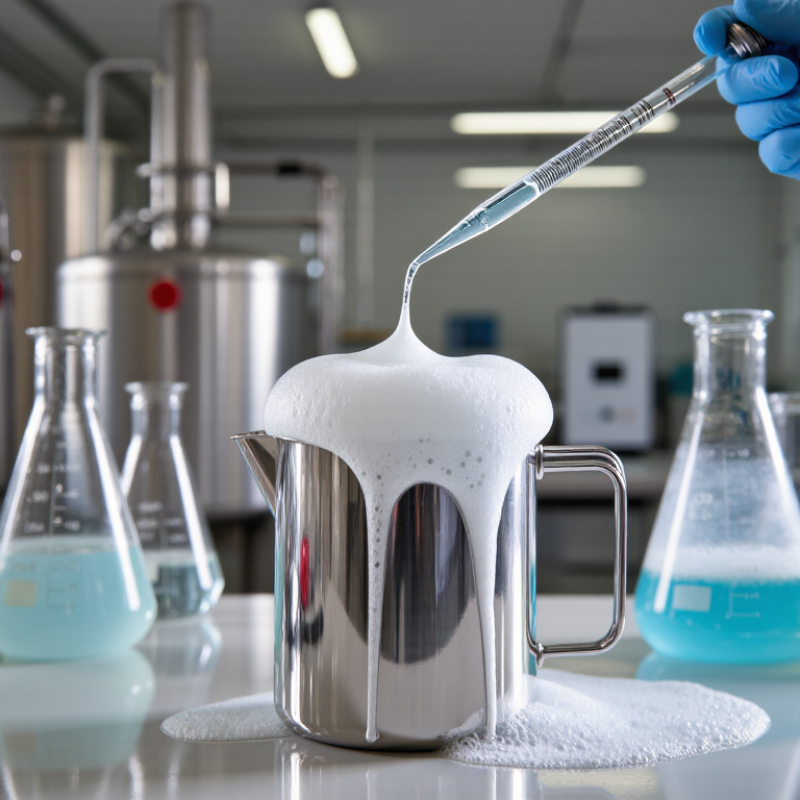
Choosing a chemical defoamer starts with identifying the foam, not selecting a product by name. Is it a dry, persistent surface blanket, or fine bubbles trapped in a circulating liquid? Protein-rich wastewater, detergent rinses, and fermentation broths can behave differently. A small jar test can show whether foam collapses quickly or returns after mixing.
Then map the actual process conditions. Record temperature, pH, salinity, flow rate, and mixing intensity where the foam forms. Heat and high shear may change performance, as can contact with filters, coatings, or downstream treatment. Check compatibility and handling guidance before a trial, and follow site procedures. Bench results help, but they do not perfectly reproduce a full tank.
Define how long control must last. A brief overflow may need fast knockdown, while a continuous line may require lasting suppression. Check foam height after five minutes, then again after thirty, or use intervals suited to the process. Test the dose in small steps; excess can leave deposits or disrupt later operations. Plant records are sometimes incomplete, so note the starting dose, conditions, and any foam rebound. Small trials matter. Adjust only after reviewing results under comparable conditions.
Silicone defoamers often have surface tensions around 20–25 mN/m, helping them spread quickly across foam films. In a mixing tank, a small dose may collapse stubborn bubbles before they reach the overflow. That speed can be useful in coatings, wastewater treatment, and other demanding processes. Yet silicone may leave residues or cause craters in a later coating layer. Low surface tension is helpful, not a guarantee of fit.
Mineral-oil defoamers can offer persistent foam control, but their dispersion and residue may affect a finished product. Polyether types are often selected when water compatibility matters; performance can change with temperature and formulation. Check the whole process, not just the foam. A defoamer that works in a beaker may behave differently under high shear or during continuous production. No option is perfect, and that uncertainty deserves a real trial.
Tips: Test each candidate at the operating temperature and mixing speed. Start with small doses, then record foam height, collapse time, and any surface defects. Small doses first. Also check downstream steps, such as filtration or painting. A simple trial log can prevent an attractive lab result from becoming an expensive production surprise.
Indicative surface-tension ranges for common defoamer types (mN/m)
Silicone defoamers typically have the lowest surface tension (about 20–25 mN/m), while mineral-oil and polyether types often fall in higher, overlapping ranges. Lower surface tension can support spreading and foam-film disruption, but it does not by itself predict performance; formulation compatibility, dosage, temperature, and the process medium also matter. Values are indicative and vary with composition and measurement conditions.
A suitable chemical defoamer must work in the process, not just in a supplier’s test cup. Check the operating pH, because acidic or alkaline conditions can change an emulsion’s stability and performance. Silicone-based, mineral-oil, and polyether defoamers behave differently; none is universally compatible. Small changes matter. Record foam height and collapse time at the pH your product actually reaches.
Temperature and shear also shape results. A defoamer that performs well in a cool tank may lose effectiveness in a hot line, where viscosity and dispersion can change. High-speed mixing or pumping may break droplets apart—or distribute the additive too finely to control foam. Test at representative temperatures and mixing speeds. Then check product compatibility: look for separation, haze, surface defects, or unwanted changes in texture. A neat lab result can still mislead. Compare a small dose range in the real formulation, allow time for the product to settle, and document what changed. The first test may not be the right one.
How to Choose the Right Chemicals Defoamer for Your Needs?
Screen Starting Dosages of 0.01–1.0 wt% with Bench-Scale Foam Tests
A bench-scale test can narrow the dosage range before production trials. Treat 0.01–1.0 wt% as a screening window, not a fixed recommendation. For a 100 g sample, that range equals 0.01–1.0 g of defoamer. Check whether the percentage refers to the supplied product or its active content, and use one basis throughout. A practical test ladder might include 0.01, 0.05, 0.1, 0.25, 0.5, and 1.0 wt%. Keep the untreated sample as a control.
Control the details. Use the same liquid volume, temperature, vessel, and mixing time for each trial. Add the defoamer consistently, then record foam height immediately and after one and five minutes. A clean-looking result can mislead. Some products collapse foam quickly but allow it to return, or affect appearance and process performance. Repeat promising doses, since small changes in mixing can shift results. If the best result lies between two test levels, run a narrower dose series there. The first pass is only a guide; real process conditions may behave differently.
A defoamer that performs well in a laboratory jar may behave differently on a production line. Temperature, shear, water quality, and feed rate can all change its effect. Test candidates in the actual process, not just in a convenient sample. Keep conditions as consistent as possible.
Measure more than foam height. Record how quickly foam collapses, whether it returns downstream, and whether the treated product shows defects. Use a fixed observation point, such as a sight glass, and log readings at regular intervals. Check dispersion too. Poorly dispersed droplets may leave oily spots or create uneven results. A clean-looking tank is not enough.
Include the proposed dose range and addition point in the trial. Small changes matter. Run long enough to observe a full production cycle, while noting any changes in raw materials or operating conditions. Trial plans can look more precise than a busy plant allows; document deviations rather than hiding them. Confirm that the formulation and its handling instructions meet applicable site requirements. Then compare total cost per unit of acceptable product, including waste, downtime, and extra mixing. A low price per kilogram may not mean a lower process cost.
| Trial Stage | Dimension | What to Test or Record | How to Evaluate | Decision Guide |
|---|---|---|---|---|
| Screening | Defoamer chemistry | Compare relevant chemistry families, such as silicone-based, mineral-oil-based, polyether-based, or water-based formulations. Record the formulation type and recommended addition method. | Check compatibility with the process liquid, operating temperature, pH, and any downstream coating, printing, bonding, or finishing steps. | Use chemistry family as an initial filter only. Performance and compatibility depend on the complete formulation and process conditions. |
| Baseline | Process conditions | Record batch size, temperature, pH, solids content, mixing speed, air entrainment, production rate, and current foam-control practice. | Run a control trial without the candidate defoamer, where operationally safe, and measure foam under representative production conditions. | Keep operating conditions consistent between the control and candidate trials so results can be compared meaningfully. |
| Performance | Foam reduction | Measure foam height or volume at defined time points before and after dosing. Record overflow, entrained air, and any process interruptions. | Foam reduction (%) = [(control foam measurement − treated foam measurement) ÷ control foam measurement] × 100. Use the same measurement method and time points for each trial. | Set the required reduction from the process need. A lower foam level is useful only if it does not create unacceptable product or process defects. |
| Performance | Persistence and re-foaming | Measure foam after dosing and again after a defined period or process step. Note whether foam returns after agitation, recirculation, or transfer. | Compare foam measurements over time and document the process conditions at each observation. | Prefer a candidate that controls foam for the required process duration without repeated, excessive additions. |
| Dispersion | Ease of distribution | Record dilution requirements, addition point, mixing time, mixing conditions, visible droplets, surface slicks, and any localized deposits. | Check dispersion in the actual process liquid using the proposed production addition method. Confirm whether pre-dilution or a specific mixing sequence is needed. | Good dispersion supports consistent performance. Do not assume that a concentrate will distribute uniformly without process-specific testing. |
| Compatibility | Product and process quality | Inspect product appearance and relevant quality measures, such as surface defects, fish-eyes, craters, spots, gloss, adhesion, or filtration behavior where applicable. | Compare treated samples with the control and apply the established quality checks for the finished product and downstream operations. | Reject or reformulate a candidate if foam control causes unacceptable quality issues, even when foam reduction is strong. |
| Compliance | Regulatory and customer requirements | Review the current safety data sheet, ingredient disclosure requirements, applicable chemical inventories, and restrictions for the intended market and use. | Confirm requirements with the site’s environmental, health, safety, and regulatory teams. Check wastewater, food-contact, or other sector-specific rules when relevant. | Approval is specific to the formulation, use, location, and applicable rules. Do not infer compliance from a chemistry family name alone. |
| Operations | Handling and storage | Record required storage conditions, shelf life, freezing or temperature sensitivity, settling, separation, and handling precautions. | Review supplier documentation and observe the material during storage and routine plant handling. | Include handling reliability and storage needs in the selection, particularly where dosing equipment or site conditions are limiting. |
| Economics | Cost at use level | Record purchase cost, product dosage, active content if available, dilution, and any extra labor or equipment needs. | Cost per production unit = product cost per mass unit × product dosage per production unit. Use consistent units and include relevant handling or waste costs. | Compare cost at the dosage that meets the process requirement, not just the price per kilogram or litre of concentrate. |
| Production trial | Repeatability and scale-up | Repeat trials across representative batches, shifts, or operating conditions. Record dosage, foam measurements, quality results, and process interruptions for each run. | Compare results across runs and check that dosing and mixing can be controlled at production scale. | Select a candidate only after it delivers repeatable foam control, acceptable product quality, workable dispersion, and verified compliance at an economical use level. |
| Interpretation | Trial acceptance criteria | Define process-specific limits for foam, product quality, compliance, handling, and cost before starting the trial. | Score each candidate against the same pre-agreed criteria and document exceptions, adjustments, and final dosage. | No single dosage, foam-reduction target, or chemistry family is suitable for every process. Establish acceptance limits using the actual formulation and production conditions. |
Contact
KYOCERA SGS Precision Tools, Inc.
(330) 686-5700
150 Marc Drive
Cuyahoga Falls, OH 44223
Products
Resources