
Choosing a Water Cooler Machine is less about appearance and more about matching the unit to its daily workload. Beverage Marketing Corporation’s 2024 U.S. bottled-water report estimated 2023 consumption at 15.9 billion gallons, or 47.3 gallons per person. That figure describes bottled-water use, not cooler sales, but it highlights how often people rely on convenient drinking water. A cooler in a quiet home has different demands from one beside a busy office break room.
Start with the water source. Bottle-fed models can work where plumbing is unavailable, though replacement bottles need storage and regular handling. Point-of-use machines connect to a water line and may reduce bottle deliveries, but installation and filter changes require planning. Check dispensing speed, hot-water safety features, cooling capacity, noise, and the space needed for cleaning. Small details matter. A crowded counter can make even a capable machine frustrating.
Water quality and upkeep deserve equal attention. Review local water information, follow the manufacturer’s cleaning schedule, and confirm filter replacement costs before buying. NSF/ANSI certifications can help verify specific contaminant-reduction claims; check that the exact model and filter are certified for the claims being made. A certification is not a promise that every filter removes every contaminant. Nor does a polished touchscreen guarantee reliable performance. Compare service access, warranty terms, and the real cost of ownership. I would also check how easy it is to sanitize the spout—an overlooked step that can matter in shared spaces.
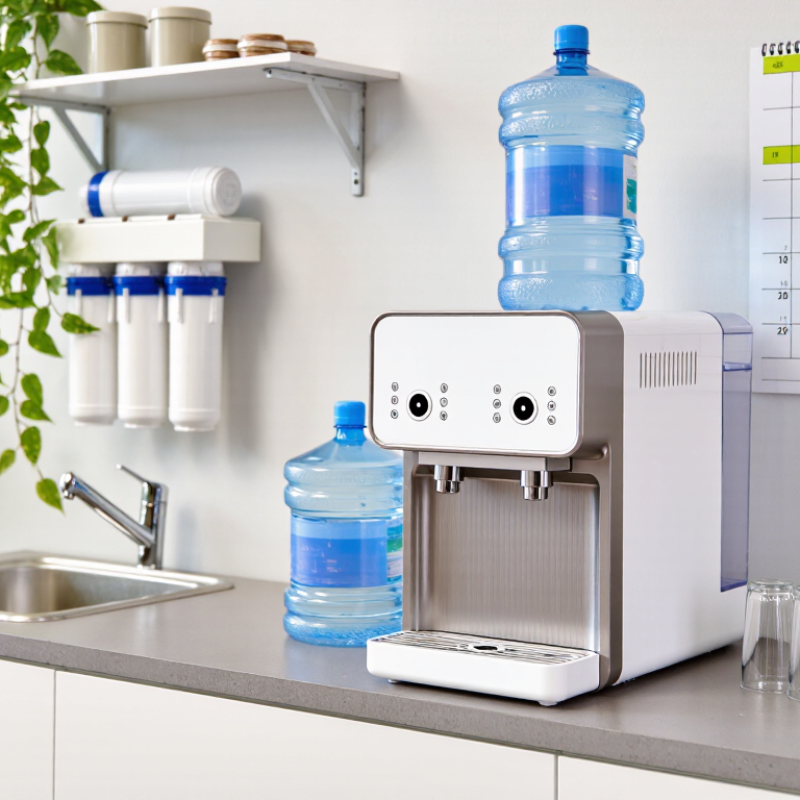
Choosing a water cooler starts with how your space gets water. Bottled models use sealed 3- or 5-gallon containers, while point-of-use units connect to a water line. The difference affects installation, storage, and daily upkeep. A cooler should fit the routine, not just the room.
A 3-gallon bottle is easier to lift and replace, which can help in a small office or home. It also runs out sooner when several people fill cups throughout the day. Five-gallon bottles need less frequent replacement, but they are heavier and need a stable storage spot. Check the unit’s loading style, too: top-loading coolers make the bottle visible, while bottom-loading designs reduce lifting but add internal components. Keep bottles clean and dry, and follow the manufacturer’s cleaning schedule. Small details matter.
Point-of-use models draw water from a plumbing connection and commonly use filters. They avoid bottle deliveries and storage, but installation may require a nearby water line and suitable access. Filter changes are easy to overlook; mark the replacement date where staff can see it. Water quality and filter needs vary by location, so check local water information and the unit’s specifications rather than assuming one filter suits every supply. A minor compromise: plumbing makes placement less flexible. Before choosing, measure the available space, estimate daily use, and consider who will handle cleaning or maintenance.

Choose a cooler by peak-hour demand, not by household size alone. The National Academies’ 2005 report, Dietary Reference Intakes for Water, Potassium, Sodium, Chloride, and Sulfate, sets adequate total-water intakes at 3.7 L daily for men and 2.7 L for women. These totals include water from food, so they are context, not a direct estimate of cooler use. Count likely users, cup sizes, and busy periods instead. Measure real use.
Compare rated cooling and heating output separately, in litres per hour. For example, 20 people drawing 250 mL each within 15 minutes need 5 L in that window—equivalent to 20 L/h if demand continued. That is a planning example, not a universal standard. Check whether the cooler’s storage tank can supply the short burst, and how quickly it recovers; hourly output alone may hide a queue at lunchtime. Check the fine print. Ratings depend on test conditions, and a warm room or repeated hot-water draws can affect recovery. Leave some headroom, but avoid paying for capacity your team will rarely use. Recheck the estimate after observing actual usage for a week.
| Use Case | Typical Users | Example Rated Cooling Output (L/h) | Example Rated Heating Output (L/h) | Capacity Selection Guidance | Features to Consider |
|---|---|---|---|---|---|
| Low-demand home use | 1–2 people | 2–3 | 4–5 | Suitable when chilled and hot water are drawn intermittently rather than in repeated large servings. | Compact footprint, child-safety lock for hot water, and easy-to-clean drip tray. |
| Shared household | 3–5 people | 3–5 | 5–8 | Allow extra output if several people commonly use the cooler at the same time, such as during breakfast. | Accessible dispensing height, stable bottle support, and clearly stated recovery time. |
| Small office or studio | 6–15 people | 5–8 | 8–12 | Choose output based on peak break-time demand, not just the average number of daily users. | Large drip tray, durable dispensing controls, and a bottle or plumbed-in configuration suited to the site. |
| Busy office or shared workspace | 16–30 people | 8–15 | 12–20 | Consider higher rated output or more than one unit if many users need water within a short period. | High-use design, straightforward cleaning access, and adequate ventilation around the unit. |
| High-traffic staff area | More than 30 people | 15–25+ | 20–30+ | Estimate the busiest-hour demand and compare it with the manufacturer’s rated output and recovery data. | Commercial-duty construction, service access, and sufficient electrical and installation capacity. |
Selection note: These figures are illustrative capacity-planning ranges, not guaranteed specifications for every machine. Compare rated cooling and heating output under the test conditions stated by the manufacturer. Actual output and recovery can vary with inlet-water temperature, room temperature, ventilation, and repeated use.
When comparing water cooler machines, inspect every part that touches water, not just the visible tank. This includes the reservoir, tubing, fittings, valves, seals, and dispensing nozzle. Small parts matter. A material may look clean yet still affect drinking water under certain contact conditions. NSF/ANSI/CAN 61 evaluates health effects from contaminants that can leach from drinking-water system components. It is not a general promise of better taste, faster cooling, or overall machine quality. Check the exact model and water-contact components against current certification records, rather than relying on a broad “NSF compliant” label.
Ask for current documentation showing the certified product, covered materials, and any use limits, such as temperature or pressure. Compare it with the machine’s actual water path and replacement parts. A certified reservoir does not automatically verify an unlisted hose or aftermarket filter. Details get messy. Keep manuals and part numbers, especially when components are replaced; otherwise, a verified setup can change quietly. If documentation is unclear, ask the manufacturer or certifier to confirm the specific configuration. I would not judge safety by stainless-steel appearance alone. Seals and internal coatings are easy to overlook, and paperwork can be less clear than it should be.
A water cooler’s filtration label can look reassuring, but the standard number matters. NSF/ANSI 42 covers aesthetic effects, such as chlorine taste, odor, and certain particles. It does not, by itself, establish reduction of every health-related contaminant. Check the specific claims, not just the logo.
For contaminants with potential health effects, look for NSF/ANSI 53 certification and confirm which substances the exact filter is certified to reduce. The scope varies. A filter may address lead, for example, without addressing other contaminants in your water. NSF/ANSI 58 applies to reverse osmosis systems and can cover reductions such as total dissolved solids, but performance claims still depend on the listed model and test conditions. Read the fine print.
Match the certification to a recent water test or local water-quality report, then check whether the cooler’s precise model appears in the certifier’s directory. Replacement filters matter, too: an expired cartridge may not perform as claimed. Look for the rated capacity and change interval, especially if several people fill bottles all day. A small detail, but an easy one to miss. Certification is useful evidence, not a promise that one machine solves every water concern.
Match each filtration claim to the relevant NSF/ANSI standard. The chart shows common alignments, not a guarantee that every product certified to a standard reduces every listed contaminant.
How to read this: “Common match” indicates a typical standard for that claim category; “Not primary” does not mean a product cannot reduce the substance. Check the specific model’s certification listing and performance data to confirm the exact claims tested.
Check the electrical rating plate and confirm the exact model is certified to UL 399, the safety standard for drinking-water coolers. A matching plug is not enough. Inspect the cord, grounding, and outlet, and ask the supplier for current certification records. UL 399 addresses electrical and related product-safety risks; it does not confirm that a cooler is clean or that its water is safe in every installation.
Cleaning deserves equal attention. CDC researchers estimated 7.15 million waterborne illnesses annually in the United States, based on 2013–2014 data published in 2020. That figure covers many exposure routes, not coolers specifically, but it shows why routine hygiene matters. Check whether the reservoir, taps, drip tray, and seals can be reached and cleaned without special tools. Follow the unit’s cleaning instructions and service schedule. A shiny cabinet can still hide residue around a faucet.
Tips: Ask for the cleaning procedure before buying. Look for removable drip trays and easy-to-access taps. Keep a simple dated cleaning log. I would not assume “low maintenance” means no maintenance. Ask who is responsible for cleaning after installation, too.
Contact
KYOCERA SGS Precision Tools, Inc.
(330) 686-5700
150 Marc Drive
Cuyahoga Falls, OH 44223
Products
Resources