How to Choose Sugar Syrup Filtration Equipment in 2026?
Choosing filtration equipment for sugar syrup in 2026 requires more than comparing catalog prices. The right system protects syrup clarity, flavor, yield, and production continuity. A small filter mistake can leave visible particles in a bright syrup tank. It can also increase pressure loss, cleaning time, and product waste.
This guide examines sugar syrup filtration through practical plant requirements. It considers syrup temperature, viscosity, flow rate, suspended solids, and the required filtration grade. Bag filters may suit simple prefiltration, while cartridge, candle, or pressure leaf systems may support finer control. The best choice depends on the process, not the equipment label. That sounds obvious, but it is often overlooked.
Hygienic design matters. Confirm the contact materials, seals, drainability, and cleaning method. Request test data, maintenance records, and references from comparable sugar plants. A reliable supplier should explain pressure limits and replacement intervals clearly. Ask how the system performs after repeated cleaning cycles. Laboratory results alone are not enough. Real production conditions can be less forgiving.
No checklist is perfect. Syrup behavior may change with temperature, concentration, or seasonal raw-material variation. Therefore, plant trials and documented validation remain valuable. Operators should monitor differential pressure, flow stability, and filtrate appearance during commissioning. A clear tank does not always prove efficient filtration. It may hide excessive energy use or premature media blockage. Careful selection creates a more balanced system, combining product quality, operating cost, sanitation, and dependable long-term performance.
Sugar Syrup Filtration Basics and Equipment Types
How to Choose Sugar Syrup Filtration Equipment in 2026?
sugar syrup filtration begins with understanding the liquid, not the machine. Syrup carries crystals, carbon particles, scale, and sometimes fine process debris. Its high viscosity can reduce flow sharply. Temperature also changes viscosity, so filtration tests should use real production conditions. A clear sample does not always prove stable performance.
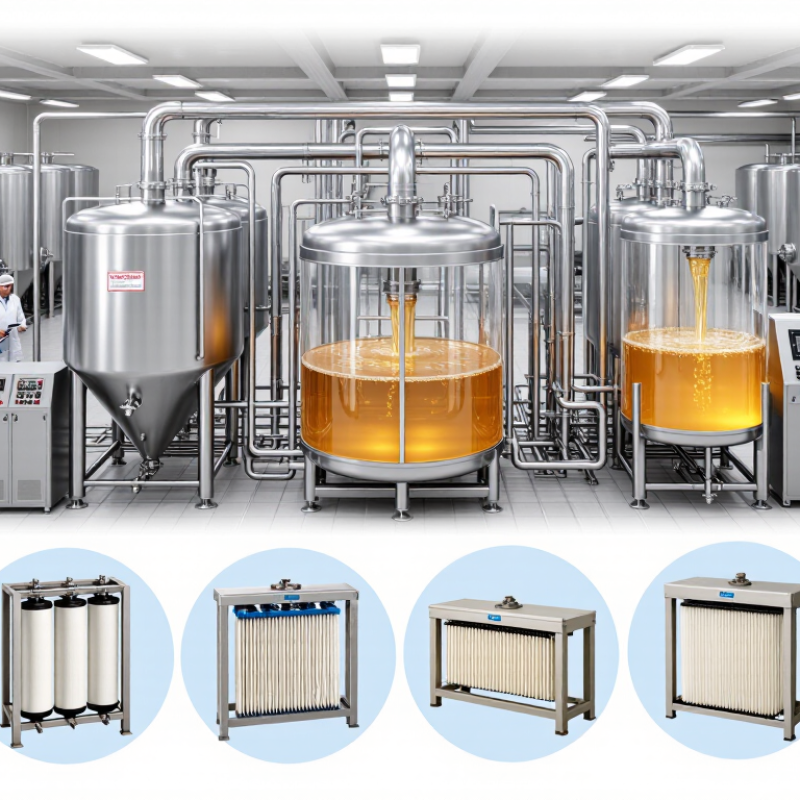
Common equipment includes bag filters, cartridge filters, plate-and-frame units, candle filters, and membrane systems. Bag filters handle larger particles and offer simple operation. Cartridge filters provide finer polishing before filling or storage.
Plate-and-frame systems suit syrup containing more solids, while candle filters support continuous processing. Membranes can achieve tighter separation, but fouling and cleaning demands may become difficult. No filter solves every problem.
Tips: Check flow rate, syrup temperature, particle size, pressure drop, and cleaning compatibility together. Choose food-contact materials with traceable documentation. Install pressure gauges before and after the filter housing.
A rising pressure difference signals loading, even when the syrup still looks bright. In 2026, digital sensors can support condition monitoring and maintenance planning. However, sensors need calibration. Operators should still inspect filter surfaces and record actual cycle times.
Start with a pilot test using production syrup. Laboratory water tests can mislead, especially with thick syrup. My recommendation may change after reviewing seasonal sugar quality, because one fixed specification rarely fits every batch.
Key Quality, Capacity, and Process Requirements
How to Choose Sugar Syrup Filtration Equipment in 2026?
Key Quality, Capacity, and Process Requirements
Choosing sugar syrup filtration equipment starts with the syrup, not the machine catalog. Measure viscosity, temperature, color, crystal content, and suspended particles during real production. A clear sample can hide problems.
Filter quality depends on more than pore size. Select food-contact materials with smooth surfaces and cleanable joints. Confirm the equipment supports hygienic drainage and controlled pressure. In plant trials, pressure rising too quickly often indicates unsuitable media or excessive solids. A lower pressure target may protect clarity and reduce product loss. Small details matter.
Capacity must match both average flow and peak demand. Calculate hourly volume, batch frequency, filtration cycles, and cleaning time. Do not size equipment only for today’s output. Seasonal production may expose a weak assumption. However, oversizing can increase waste and energy use. That trade-off deserves a real cost review.
The process design should fit upstream heating and downstream filling. Check syrup temperature limits, pump compatibility, and available floor space. Automatic monitoring can record pressure, flow, and filter life. Manual checks still matter. Operators should inspect seals, sample filtrate, and verify cleaning results. I would request a pilot test using actual syrup before approval. Laboratory water tests are useful, but they rarely reveal every production challenge.
How to Choose Sugar Syrup Filtration Equipment in 2026?
Typical nominal filtration ratings by sugar syrup process stage
Coarse protection commonly uses screens of about 500–1,000 μm to remove large particles. Clarification stages often operate around 25–100 μm, while final polishing may use approximately 1–10 μm, depending on syrup concentration, temperature, viscosity, product quality targets, and allowable pressure drop. Equipment capacity should be selected from the required flow rate at the lowest operating temperature, not only from the average production rate.
How to Compare Filtration Technologies in 2026
Choosing sugar syrup filtration equipment in 2026 requires more than checking the smallest micron rating. The International Sugar Organization reported global sugar production near 180 million tonnes for 2023/24, showing the scale of modern processing. At this volume, pressure stability, cleaning time, and syrup recovery directly affect operating costs. Compare depth filters, cartridge filters, membrane systems, and centrifuges against the same feed conditions. Measure turbidity, color, viscosity, temperature, flow rate, and differential pressure.
Membrane filtration can deliver consistent particle removal, but concentrated syrup may reduce flux quickly. The MarketsandMarkets Membrane Filtration Market report projected growth from approximately USD 16 billion in 2024 to more than USD 22 billion by 2029. Market growth does not guarantee suitability. Ask suppliers for pilot data using syrup with comparable Brix levels. A laboratory water test is not enough. It can mislead.
For each technology, calculate filtration cost per tonne, product loss, energy use, and cleaning chemical demand. Track the pressure rise across the filter during a full production shift. A low initial price may become expensive after frequent element replacement. Hygienic design also matters: inspect dead legs, drainability, gasket materials, and cleaning validation records. The Codex General Principles of Food Hygiene, CXC 1-1969, supports preventive control and documented sanitation practices. In practice, operators sometimes overvalue clarity and undervalue maintenance access. That is a mistake. The best comparison uses measured performance, verified hygiene controls, and realistic downtime assumptions.
Selecting Materials, Automation, and Cleaning Features
In 2026, sugar syrup filtration should be selected around hygiene, heat, and cleaning time. Start with the syrup. Its temperature, viscosity, crystal risk, and suspended solids determine the filter design. Use food-contact stainless steel, preferably 316L, with welded joints and a documented surface finish. Hygienic engineering guidance commonly targets Ra 0.8 micrometres or smoother on product-contact surfaces. Plastic parts also need temperature and chemical compatibility evidence.
Automation deserves practical restraint. A 2023 State of Smart Manufacturing report surveyed 1,353 manufacturers; 95% had invested or planned investment in smart technologies. For syrup lines, useful automation includes differential-pressure alerts, flow monitoring, temperature records, and automatic diversion during filter loading. Do not automate every valve blindly. A simple alarm may outperform a complicated system when operators lack training. That is easy to forget.
Cleaning features can protect both yield and food safety. Choose drainable housings, minimal dead legs, smooth internal geometry, and validated clean-in-place connections. The 2024 Global Food and Beverage Industry Outlook highlights labour efficiency and sanitation reliability as continuing investment priorities. A washable filter element may reduce waste, but only when cleaning validation proves consistent performance. Record rinse conductivity, return temperature, cycle duration, and final visual condition. In practice, operators often focus on pressure readings and overlook syrup trapped behind gaskets. That weakness needs review.
Evaluating Costs, Compliance, Suppliers, and Long-Term Value
How to Choose Sugar Syrup Filtration Equipment in 2026?
Sugar syrup filtration decisions now require more than comparing purchase prices. USDA’s November 2024 Sugar: World Markets and Trade report forecast global sugar production at about 186.6 million metric tons for 2024/25. That scale increases pressure on stable throughput, hygienic design, and predictable maintenance. Ask suppliers for validated flow rates using your actual syrup temperature, Brix, and suspended-solids load. A polished housing means little if the filter blocks during the afternoon shift.
Compliance must be documented, not promised. The FDA’s 21 CFR Part 117 framework emphasizes sanitation, hazard controls, and preventive procedures for food facilities. Codex General Principles of Food Hygiene, revised in 2022, also supports risk-based verification and traceability. Require material certificates, clean-in-place instructions, pressure limits, and change-part records. Keep the paperwork practical. Operators need clear steps beside the skid, not a manual hidden in procurement files.
Long-term value depends on total cost. Include cartridges, seals, water, cleaning chemicals, labor, energy, disposal, and lost production. For example, calculate the cost of each pressure-driven shutdown at your real hourly contribution margin. Compare suppliers over five years, not five minutes. Request two customer references with similar syrup concentration and production volume. One weakness remains: laboratory tests may not reproduce seasonal temperature changes or crystallization. Pilot trials are imperfect, but skipping them is usually worse. Supplier responsiveness matters when a filter fails at 2 a.m.
How to Choose Sugar Syrup Filtration Equipment in 2026? - Evaluating Costs, Compliance, Suppliers, and Long-Term Value
| Filtration Option | Typical Use | Nominal Rating | Typical Flow Range | Indicative Equipment Cost | Estimated Annual Consumables | Product Loss Risk | Hygienic Design Considerations | Typical Service Life | Indicative Lead Time | Compliance Focus |
| Bag Filter Housing | Coarse clarification and pre-filtration | 25–100 micrometres | 2–40 m³/h | US$1,500–8,000 | US$500–6,000 | Low to medium | Use sanitary stainless steel, drainable piping, food-contact gaskets, and tool-free access where possible. | 8–15 years for housing | 4–12 weeks | Food-contact materials; hygienic fabrication; validated cleaning procedure |
| Cartridge Filter System | Fine polishing before filling or blending | 0.2–10 micrometres | 0.5–20 m³/h | US$3,000–18,000 | US$2,000–20,000 | Medium | Select low-hold-up housings and compatible membrane or depth-media cartridges; confirm extractables requirements. | 8–15 years for housing | 6–16 weeks | Food-contact declarations; differential-pressure monitoring; microbial-control validation when required |
| Candle or Candle-Stack Filter | Continuous clarification of high-volume syrup | 1–25 micrometres | 5–80 m³/h | US$20,000–100,000 | US$3,000–25,000 | Low when correctly sized | Requires effective backwashing or cleaning, complete drainage, sanitary welds, and controlled solids discharge. | 10–20 years | 12–28 weeks | HACCP controls; cleanability; pressure-vessel and food-contact requirements where applicable |
| Rotary Vacuum or Pressure Filter | Large-volume clarification with high solids loading | 5–50 micrometres | 20–150 m³/h | US$80,000–350,000 | US$8,000–60,000 | Medium | Needs hygienic product-contact surfaces, enclosed solids handling, access for inspection, and a documented cleaning cycle. | 15–25 years | 20–40 weeks | Machine guarding; pressure and vacuum safety; food-safety preventive controls |
| Crossflow Microfiltration | High-clarity syrup and microbial-reduction applications | 0.1–1.4 micrometres | 1–30 m³/h | US$120,000–500,000 | US$10,000–80,000 | Low to medium | Requires validated cleaning chemistry, membrane-integrity checks, sanitary instrumentation, and temperature control. | 10–15 years for skid | 20–45 weeks | Process validation; membrane integrity; documented sanitation and traceability |
| Depth Filter Press | Batch clarification and colour or solids removal | 1–20 micrometres | 1–25 m³/h | US$8,000–60,000 | US$4,000–35,000 | Medium to high | Confirm media compatibility, prevent fibre shedding, provide safe plate opening, and control operator exposure during changeover. | 10–20 years for frame | 8–20 weeks | Food-contact media; allergen and foreign-material controls; cleaning verification |
Cost and selection notes: Cost ranges are indicative 2026 planning values in US dollars for sanitary food-processing equipment and normally exclude taxes, freight, installation, utilities, validation, and civil works. Actual capacity depends on syrup concentration, temperature, viscosity, suspended-solids loading, required clarity, pressure drop, cleaning method, and operating hours. Supplier evaluation should include application testing, guaranteed performance criteria, spare-parts availability, documentation quality, cleaning validation support, and total cost of ownership over the intended service life.