What Types of Wooden Doors Are Best for Your Project?

Choosing the right Wooden Doors starts with understanding where each door will be used. A quiet bedroom, a busy hallway, and an exposed entrance place different demands on materials and construction. Solid wood offers a substantial feel and can often be repaired or refinished, but it may respond to changes in humidity. Engineered wood can provide greater dimensional stability, while hollow-core doors are lighter and often suit closets or low-traffic interior spaces. Each option has trade-offs.

Details matter. A front door needs suitable weather protection, secure hardware, and a finish intended for exterior exposure. Interior doors should match the room’s privacy, sound-control, and durability needs. For example, a solid-core door may help reduce noise between a home office and a living area, while a lighter door may be practical for a closet. Check the manufacturer’s specifications, including the door’s construction, finish, and care requirements. Also measure the opening carefully; an attractive door that does not fit is still the wrong choice.

There is no single best type for every project. Budget, climate, maintenance, style, and installation conditions all shape the decision. Even experienced renovators can overlook how much daily use affects a door’s long-term performance. I would compare samples in the actual room, where daylight and nearby finishes can change their appearance. A little uncertainty is normal. The goal is a door that fits the space, performs reliably, and remains practical to maintain.
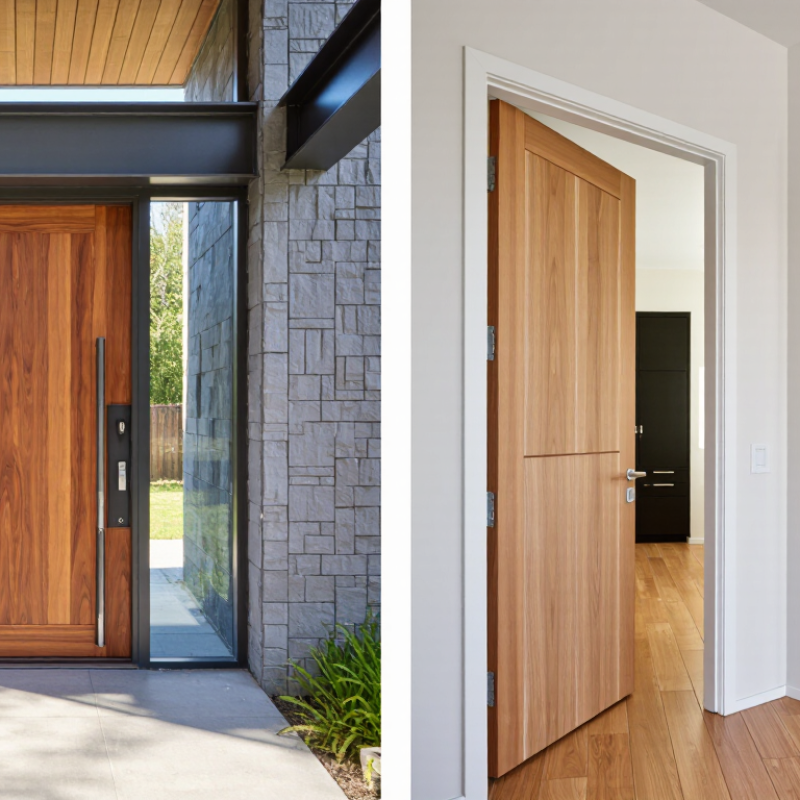
What Types of Wooden Doors Are Best for Your Project?

Assess Your Project’s Use, Location, and Performance Needs

A door should match the way a room is used, not just its style. For a busy hallway, a solid-core wooden door can help soften everyday noise and feel more substantial under repeated use. A lightweight hollow-core option may suit a quiet closet, where sound control matters less. Exterior doors face a tougher mix: rain, sun, temperature swings, and frequent opening. Species, construction, protective finish, and the quality of the frame all affect performance. There is no single best choice.

Location can change the decision. The USDA Forest Products Laboratory’s Wood Handbook (FPL-GTR-282, 2021) reports that, at 70°F, wood’s equilibrium moisture content is about 6% at 30% relative humidity and about 20% at 90%. That difference matters: changing moisture can make wood move, so a door in a humid entry may need careful detailing and regular finish checks. This is easy to overlook. A specification alone cannot prevent problems caused by poor installation or neglected maintenance.

Tips: Check the room’s traffic, privacy, and moisture exposure before choosing. Ask how the door is built, and confirm that its finish suits the location. Leave room in the budget for installation; that part is easy to underestimate.

Understand the Main Types of Wooden Door Construction

Wooden doors are built in several ways, and the construction affects weight, stability, sound control, and repair options. Solid-wood panel doors use joined boards or panels and show natural grain, but seasonal movement can loosen joints or create sticking. The USDA Forest Products Laboratory’s Wood Handbook places fiber saturation near 30% moisture content for many species. Below that point, wood dimensions change as moisture levels shift. That matters near damp bathrooms, exterior walls, and unconditioned entryways.

Stile-and-rail doors have vertical stiles, horizontal rails, and inset panels. Their frame-and-panel design allows movement while keeping the door visually detailed. Flush doors instead use flat faces over a core: hollow-core versions are lighter, while solid-core versions feel heavier and generally offer better sound reduction. Engineered cores can also improve dimensional stability, though quality varies by materials and assembly. Look closely at the edges. That is where weak bonding may show. For a high-traffic room, a solid core may be worth its weight; for a closet, hollow core can be practical. I still find the choice less obvious in humid homes. Installation gaps, finish quality, and indoor moisture can matter as much as the door’s label.

Compare Wood Species, Finishes, and Design Options

Wood species shape a door’s grain, color, weight, and response to humidity. Oak offers pronounced grain and a strong visual pattern; maple has a finer, quieter surface, while walnut brings a naturally darker tone. These differences show most clearly under clear finishes. Stains can deepen color, but may look uneven across boards, so test a sample first. Small details count.

The USDA Forest Products Laboratory’s Wood Handbook (2010) reports white oak shrinkage of about 5.6% radially and 10.5% tangentially, from green to oven-dry condition. These figures describe major moisture loss, not normal indoor door movement, but they illustrate why stable moisture and careful construction matter.

A well-sealed finish slows moisture exchange; it does not stop it. For a painted door, maple or a paint-grade wood can provide a smoother base, while a clear finish suits expressive grain. Flush designs feel spare; stile-and-rail panels add depth and shadow. Glass inserts can brighten a hallway, though they reduce privacy.

I would still compare full-size samples in the project’s actual light. A sample can surprise you.

Match Door Types to Interior and Exterior Applications

A door’s location matters more than its style. For bedrooms, studies, and hallways, solid-core wooden doors offer better sound control and a substantial feel. Hollow-core doors are lighter and often suit closets or low-traffic rooms, though they provide less privacy. For bathrooms and laundry rooms, look for a suitable protective finish and keep the door edges sealed. Repeated moisture can still cause swelling.

Exterior doors face rain, sun, and changing temperatures. A well-built solid-wood door can work well under a covered entry, but it needs regular finish checks. Engineered wood constructions may offer greater dimensional stability, depending on their materials and build. Add a proper threshold, weatherstripping, and careful installation; even a good door can let drafts through if the frame is poorly fitted. I’d also consider how much direct afternoon sun the doorway gets. That detail is easy to overlook.

Tips: Match the door to its exposure, not just its room. Check the manufacturer’s care guidance, inspect edges and joints, and maintain exterior finishes before bare wood appears. When in doubt, ask an experienced installer to assess the opening and local conditions.

What Types of Wooden Doors Are Best for Your Project?

Typical fit for interior and exterior applications

Solid-core doors are commonly suited to interior rooms where added mass is useful, while hollow-core doors are a lightweight interior option. Solid wood and some engineered wood doors can be used outside when designed and finished for weather exposure. Scores are a qualitative selection guide, not product test results; exterior suitability depends on construction, finish, and installation.

Evaluate Cost, Maintenance, and Long-Term Durability

Wooden doors differ in purchase price, upkeep, and how well they handle moisture. Hollow-core doors usually cost less and suit dry interior rooms, but they offer less impact resistance. Solid-wood doors feel substantial and can be repaired, though exposed finishes need periodic inspection and renewal. Engineered-wood doors often provide a steadier middle ground: layered construction can reduce movement, but edge damage still needs prompt sealing. One trade-off is easy to miss.

The USDA Forest Products Laboratory’s 2021 Wood Handbook reports total shrinkage of roughly 6% to 17% across wood species, from green to oven-dry condition. That is lumber data, not a service-life prediction for finished doors, but it explains why humidity and exposed end grain matter. For an exterior opening, check the sill, bottom edge, and finish after wet seasons; small coating failures can invite swelling and sticking. In a sheltered interior, maintenance demands are usually lighter. Still, local climate and installation quality can outweigh species choice.

Compare the full cost, not just the invoice: include finishing, hardware, weatherstripping, and future touch-ups. A painted engineered door may be practical where rain hits hard; a well-protected solid-wood door may suit a sheltered entry. Neither choice is maintenance-free. Ask suppliers for construction details and finish-care guidance, then check whether repairs are feasible before choosing.

What Types of Wooden Doors Are Best for Your Project? — Evaluate Cost, Maintenance, and Long-Term Durability

Door Type Typical Material Cost Maintenance Long-Term Durability Moisture Considerations Best Suited For
Solid Hardwood
Made from hardwood boards or panels.
About $200–$1,000+ per interior door slab. Inspect the finish periodically; sand and refinish when worn. Keep the door sealed and promptly repair scratches or finish damage. High when well-made and maintained. Can be repaired and refinished, but may dent, warp, or move with changes in humidity. More vulnerable to swelling and movement in damp or changing conditions. Use an appropriate finish and avoid prolonged exposure to water. Projects prioritizing natural wood appearance, repairability, and a premium feel.
Solid Softwood
Typically made from species such as pine or fir.
About $100–$500 per interior door slab. Paint or seal exposed surfaces; touch up dents and scratches as needed. Softwood often benefits from a durable protective finish. Moderate to high, depending on construction and care. It is generally easier to dent than many hardwoods but can be repaired and refinished. Can swell, shrink, or warp as humidity changes. Sealing all faces and edges helps reduce moisture-related movement. Painted interiors, traditional designs, and projects seeking a natural-wood door at a lower cost than many hardwood options.
Engineered Wood with Wood Veneer
An engineered core covered with a real-wood veneer.
About $150–$600 per interior door slab. Clean gently and protect the veneer from deep scratches and excess moisture. Refinishing options depend on veneer thickness. Often more dimensionally stable than solid wood, but surface damage can be harder to repair if the veneer is thin. The engineered core can be stable, but water may damage the veneer or edges. Keep surfaces and joints protected. Projects seeking the appearance of real wood with more consistent construction and less movement than many solid-wood doors.
Solid-Core Composite with Wood Veneer or Finish
A dense composite core with a decorative wood surface.
About $100–$500 per interior door slab. Usually requires routine cleaning and occasional touch-ups. Avoid abrasive cleaners and protect the surface from chips. Generally sturdy and offers better sound reduction than hollow-core doors. Damaged skins may be difficult to restore seamlessly. Core and surface performance vary by product. It is not automatically suitable for wet areas; check the door’s moisture rating. Bedrooms, bathrooms, and other interior spaces where a substantial feel and improved sound control are priorities.
Hollow-Core Molded Wood-Fiber
Molded wood-fiber skins over a lightweight internal frame.
About $50–$200 per interior door slab. Clean gently and repair small surface marks with care. The thin skin can be damaged by impacts and may not tolerate extensive sanding. Low to moderate. Lightweight construction is suitable for everyday interior use but is less resistant to impacts than solid-core options. Keep away from standing water and persistent dampness; the skin and edges can be damaged by moisture. Budget-conscious interior projects, closets, and low-traffic areas where sound insulation is not a major requirement.

Cost note: Prices are broad, indicative U.S. material-only estimates for standard interior door slabs. They exclude installation, hardware, finishing, and any frame or trim; actual prices vary by size, construction, wood species, finish, and location. For exterior doors or damp locations, verify that the specific door is rated for the intended use.