
Interest in plant-based ingredients is growing, but “vegan gelatin” is not animal gelatin. It usually means a gelling alternative, such as agar, pectin, or selected starch blends. The Good Food Institute’s 2023 U.S. retail report valued plant-based food sales at $8.1 billion. That figure signals broader consumer interest, not gelatin-specific demand. This distinction matters when comparing suppliers in China. A product’s name alone cannot confirm its ingredients, performance, or organic status.
For buyers searching “Organic Gelatin Vegan,” the key question is whether a supplier can document both the plant-based formulation and its organic claim. Ask for current certificates, ingredient specifications, allergen information, and batch-level traceability. Request samples for the actual application: a fruit gummy, dessert, or beverage can behave differently under heat and acidity. Small details matter. A transparent supplier should explain gel strength, setting time, and recommended usage, rather than promise a perfect substitute for every recipe. Independent testing and clear export documentation add confidence, but certificates should be checked against the intended sales market and product scope. One caution: organic certification does not, by itself, prove vegan status or consistent performance. China offers many ingredient manufacturers, yet supplier quality can vary. The best choice is therefore not simply the lowest quote. It is the partner whose evidence, sample results, and communication hold up under careful review. Even then, buyers should validate each production lot; no supplier is beyond scrutiny.
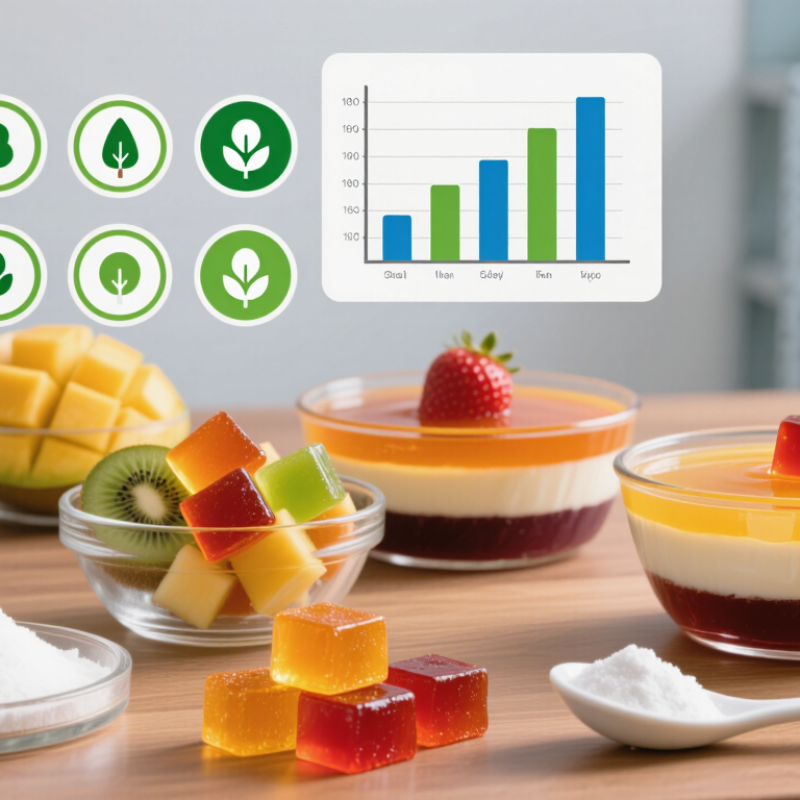
E406 agar, E407 carrageenan, and E415 xanthan can each replace some functions of animal gelatin, but they do not behave alike. Agar, derived from red seaweed, sets into a firm gel as a mixture cools. It suits fruit jellies and sliced desserts, though the texture can feel brittle rather than springy. Dissolve it fully with heat, then pour promptly; it sets quickly.
Carrageenan also comes from seaweed. Its texture varies by type: some forms create firm gels, while others give softer, more elastic results. Minerals in a recipe can change the outcome, so a small test batch is useful. Xanthan, made by fermentation, is better known for thickening and stabilizing sauces than for making a standalone gelatin-like gel. A little can reduce separation in a pourable filling. Too much, though, may turn it unpleasantly slick.
For buyers comparing Chinese suppliers, ask for the exact ingredient type, technical data, and documentation supporting any organic claim. “Plant-based” does not automatically mean organic. Check how the ingredient performs in your actual recipe, including its acidity, sugar level, and heating method. The first trial may disappoint. That is useful information: these ingredients need different handling, and a direct one-for-one swap rarely gives the texture you expect.

For a vegan gelatin alternative from a Chinese supplier, check which plant-based ingredient is offered. Agar, pectin, and carrageenan behave differently; they are not direct substitutes in every recipe. Ask for a current specification sheet and a sample from the same production grade. Organic claims should be supported by applicable certification documents and clear ingredient traceability. Paperwork matters.
Gel strength needs a stated test method, concentration, temperature, and pH; a single number is hard to compare otherwise. Viscosity affects mixing and filling. Test it at your actual processing temperature, since a powder that disperses smoothly in a lab may thicken too quickly in a heated kettle. Setting temperature also shapes production timing. Confirm when the mixture begins to set, not only when it forms a firm gel. These details can vary by formula, and I would not assume one supplier’s figures predict your finished product exactly.
Tips: Run small trials in your own recipe. Record heating time, pour temperature, and firmness after cooling. Ask for batch-specific results. A little uncertainty remains until you test it yourself.
Compare plant-based gelling agents by their typical setting-temperature ranges. These indicative ranges vary with grade, concentration, pH, salts, and processing conditions.
How to assess a supplier: Ask for gel strength results with the test method and conditions stated, viscosity at a specified concentration and temperature, and setting temperature for your formulation. Gelatin Bloom values are not directly comparable with plant hydrocolloid test results. Verify organic certification and vegan suitability for the exact product and facility.
Ranges are general reference values, not product guarantees. Confirm specifications with the supplier’s technical data sheet and test samples under your own process conditions.
China’s GB 2760-2024 took effect on February 8, 2025. It sets which food additives may be used, in which food categories, and under what conditions. For hydrocolloids such as agar, pectin, carrageenan, or konjac glucomannan, the permitted use depends on the ingredient’s identity and the finished product category. Small details matter.
A supplier should provide the precise additive name, specification, and batch documentation, not just describe a powder as “plant-based gelatin.” Check the intended use against the current standard and confirm whether a maximum level or good manufacturing practice applies. A jelly mix and a beverage may face different requirements. Keep formulation records, too. They help explain why an ingredient is used and at what level.
GB 2760 compliance does not by itself prove that a product is organic or vegan. Those claims need separate evidence, including sourcing and processing information. Ask for traceability records and check that the documents match the actual production lot. A tidy spreadsheet is useful, but it is not a substitute for reviewing the full formulation. Even experienced buyers can overlook category changes. Verify details before approving a supplier.
For a vegan product, clarify whether “gelatin” means a plant-based gelling agent, such as agar or pectin. The ingredient name alone is not proof of vegan status. Ask for the exact formulation, production-site address, and current certificates before comparing suppliers in China. Check that each document names the same legal entity and manufacturing site as the quotation.
Verify ISO 22000 and FSSC 22000 certificates directly with the issuing certification body or its online register. Confirm the certificate number, validity dates, site address, product category, and scope; a valid certificate may cover a different facility or activity. FSSC Foundation’s 2023 annual report reported more than 31,000 certified sites across 149 countries. That scale makes independent record checks practical, but it does not validate any individual supplier. HACCP requires a closer look: ask for the hazard analysis, critical control points, monitoring records, corrective actions, and recent audit findings. A HACCP claim alone does not establish that a third party certified the system.
Check that the certification body is accredited for the relevant food-safety scheme, and request a current audit summary with confidential details removed. For organic claims, verify the product-specific certificate, ingredient scope, and traceability documents separately; ISO or FSSC certification does not prove organic status. Follow one lot from incoming raw material to finished-product records. Small gaps matter. A polished PDF can still be outdated, and buyers should record what remains unverified.
When comparing suppliers of organic vegan gelling ingredients in China, start with a lot-specific Certificate of Analysis (COA), not a generic sample. Check product identity, moisture, gelling strength or viscosity, microbiological results, and test methods. Limits should match your application and internal specifications. Ask whether results come from each production lot or from periodic testing. Small details matter.
Review organic documents for the certified company, product scope, facility, validity dates, and traceability through processing and packaging. Requirements can vary by destination market, so confirm that the paperwork fits your sales plan. Also check whether the vegan ingredient is a single hydrocolloid or a blend; the difference may affect texture and labeling. A polished PDF can still leave gaps. Ask for dates.
MOQ and lead time need the same precision. Compare minimums for samples, standard production, and custom specifications, then ask whether packaging changes the order threshold. Request separate estimates for production and shipping, plus the assumptions behind each timeline. I would not treat a short quoted lead time as proof of reliable supply. It may exclude testing or document review. A small pilot order can reveal practical issues, though it cannot guarantee every later batch will behave identically.
| Comparison area | What to compare | Evidence or factual benchmark | Buyer verification |
|---|---|---|---|
| Product identity | Plant-based gelling ingredient offered as a gelatin alternative | “Vegan gelatin” is a market description, not animal gelatin. Common plant-based gelling ingredients include agar, carrageenan, pectin, and konjac glucomannan; their functionality is not interchangeable. | Request the exact ingredient name, source, composition, INS/E-number where applicable, and intended-use specification. |
| Functional fit | Gel strength, texture, setting behavior, and application | Agar, carrageenan, pectin, and konjac differ in setting conditions and gel texture. Results depend on grade, formulation, pH, sugar, ions, and processing conditions. | Compare application-specific samples and technical data; do not select on the “vegan gelatin” label alone. |
| COA — batch identity | Traceability and document matching | A COA should identify the product and grade, batch or lot number, manufacturing date, test date, and issuing facility. | Match the COA lot number to the sample label, commercial invoice, and shipment documents. |
| COA — test results | Product-specific quality and safety parameters | Relevant tests vary by ingredient and specification; possible items include appearance, moisture, pH, viscosity or gel strength, microbiological limits, and applicable contaminants. | Require numeric results, units, methods, and acceptance limits. Confirm that the listed tests suit the intended market and food application. |
| Independent testing | Verification of selected COA claims | Testing by an appropriately accredited laboratory can provide independent verification; accreditation scope should cover the relevant test methods. | For higher-risk orders, agree on pre-shipment testing, sampling procedures, and who pays for testing before placing the order. |
| Organic certification | Certification standard and validity | Relevant schemes can include China’s organic product certification under GB/T 19630, USDA National Organic Program (7 CFR Part 205), and the EU organic framework (Regulation (EU) 2018/848). Applicability depends on the product and destination market. | Check the current certificate, certifier, scope, product or ingredient coverage, facility, validity dates, and transaction documentation. A supplier’s general certificate does not automatically cover every product. |
| Organic claim and chain of custody | Whether the specific shipment can be sold as organic in the destination market | Certification and import documentation requirements depend on the importing market and supply-chain status. | Confirm the required shipment certificate or transaction documents with the certifier, importer, or relevant authority before shipment. |
| Vegan status | Animal-derived inputs and processing aids | Plant origin alone does not establish that every processing aid or component meets a buyer’s vegan requirements. | Obtain a signed statement covering ingredients, processing aids, carriers, and cross-contact controls; request supporting evidence if required. |
| MOQ | Minimum order quantity for samples, standard packs, and custom specifications | There is no universal MOQ for Chinese suppliers; it depends on ingredient, packaging, stock, customization, and order terms. | Compare written quotes in kg per SKU, sample quantity, packaging size, and any separate MOQ for certified-organic or custom products. |
| Lead time | Sample, production, and dispatch timing | Lead time is supplier-, stock-, order-, and season-specific; no single figure is reliable for all products or orders. | Request separate written estimates for sample preparation, production, document preparation, and dispatch, with the date the lead-time clock starts. |
| Price comparability | Quoted price and delivery basis | Price depends on grade, organic status, volume, packaging, and trade terms; quotes with different delivery terms are not directly comparable. | Compare the same specification, quantity, packaging, currency, Incoterm, and quote validity period. |
| Best supplier decision | Overall evidence, not a single headline claim | A suitable supplier should be able to substantiate product identity, batch-level quality, applicable certification, and agreed commercial terms. | Shortlist only suppliers whose documents, samples, MOQ, and lead-time commitments meet your written requirements. Treat unverified figures as unconfirmed. |
Contact
KYOCERA SGS Precision Tools, Inc.
(330) 686-5700
150 Marc Drive
Cuyahoga Falls, OH 44223
Products
Resources