
KYOCERA SGS Precision Tools Group
Choosing a gold-testing laboratory takes more than comparing prices. Sample preparation, analytical methods, reporting units, and turnaround times can all affect the usefulness of a result. Fire Assay is a widely used technique for determining gold content, but reliable testing also depends on careful handling and representative sampling. A precise instrument cannot fix a poorly prepared sample. Details matter.
This guide introduces ten laboratories that offer gold-testing services and explains what to check before sending material. Look for clear method descriptions, relevant accreditation, and reports that identify the sample and explain the results. Accreditation should be checked against the specific testing scope, not treated as a blanket guarantee. Ask how samples are received, prepared, and retained, especially when results may inform a purchase, refining decision, or quality review.
No single laboratory is automatically the best choice for every project. Location, sample type, required reporting limits, and budget can change the decision. That can be frustrating. Published service details may also change, so confirm current capabilities directly with each lab. The list is a practical starting point, not a substitute for reviewing methods or discussing unusual samples with qualified staff. Compare the evidence, ask specific questions, and choose a lab whose process fits the decision you need to make.
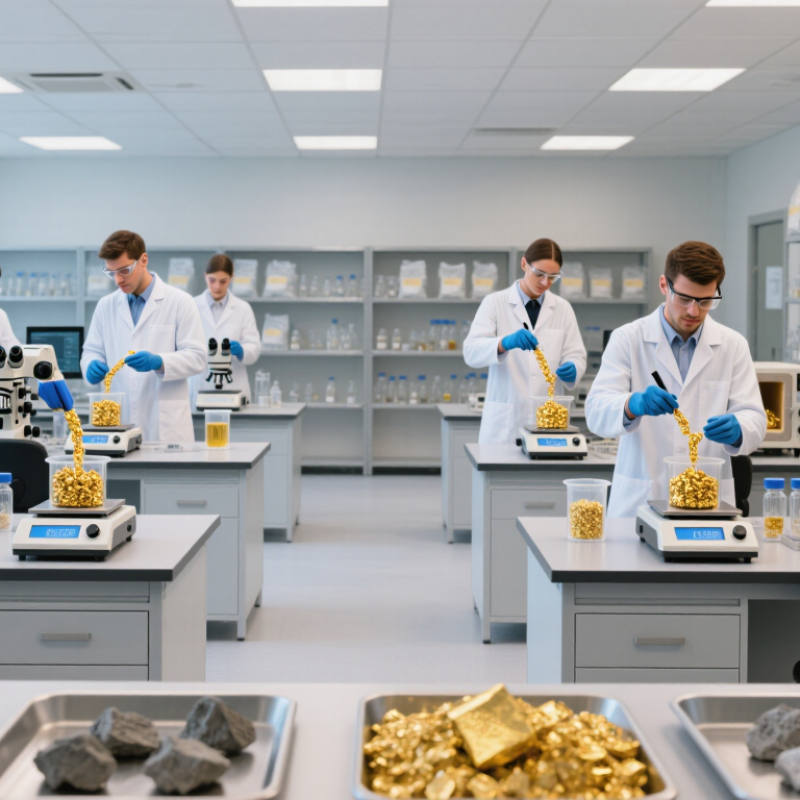
A fire assay estimates gold content by separating precious metals from the surrounding rock or material. The result depends on a representative sample, so technicians usually crush and pulverize the material before weighing a measured portion. A small scoop can change the result. That detail matters.
The weighed sample is mixed with flux, often including lead oxide and mineral compounds, then heated in a furnace. During fusion, molten lead collects gold and other precious metals in a compact button. The button is reheated in a porous cupel, where lead oxidizes and is absorbed. A small bead remains. Technicians may dissolve away silver and weigh the remaining gold, or use an instrumental finish for measurement. The chosen method can affect detection limits and reporting.
Reliable laboratories check their process with blanks, duplicate samples, and certified reference materials. These checks help reveal contamination or inconsistent recovery, though they cannot fix a poorly collected sample. Results are commonly reported as gold concentration, such as grams per tonne. Ask how the lab prepared the sample, what finish it used, and whether the report includes uncertainty. Fire assay is widely trusted, but it is not magic; uneven gold distribution can still complicate an otherwise careful test.
Use these ten practical criteria to compare fire assay laboratories. The table describes established assay practices, not a ranking of named providers; sample sizes, detection limits, and procedures vary by laboratory and should be confirmed in its current method documentation.
| No. | Comparison criterion | What a capable laboratory should provide | Why it matters for gold results |
|---|---|---|---|
| 1 | Fire assay fusion | A documented fusion procedure that mixes a prepared sample with flux and uses a collector, commonly lead, to gather precious metals into a bead. | Fusion separates the precious-metal-bearing collector from much of the silicate and other gangue material in the sample. |
| 2 | Sample preparation and aliquot | Clear instructions for drying, crushing, pulverizing, splitting, and the mass used for the assay charge. A 30 g charge is common for routine gold fire assay, but it is not universal. | Gold can be unevenly distributed in a sample. Preparation and aliquot size affect how representative the portion tested is. |
| 3 | Cupellation | A stated cupellation step in which the lead collector is oxidized and absorbed into a cupel, leaving a precious-metal bead for measurement. | This is a central part of the conventional lead-collection fire assay sequence and helps isolate the gold-bearing bead. |
| 4 | Gravimetric finish | A gravimetric option for suitable samples, with the bead weighed after the laboratory’s stated separation and measurement steps. | Direct weighing can be appropriate when gold levels are high enough for the method’s working range. |
| 5 | AAS or ICP finish | For lower-level measurements, a validated instrumental finish such as atomic absorption spectrometry (AAS) or inductively coupled plasma (ICP) analysis after fire assay collection. | Instrumental finishes can measure smaller amounts of gold than a balance-based finish; the suitable option depends on the sample and requested reporting range. |
| 6 | Screen fire assay for coarse gold | When coarse or “nuggety” gold is suspected, an optional screen fire assay that assays size fractions separately and combines their results using the documented mass proportions. | Testing a single small aliquot may produce variable results when gold particles are coarse and unevenly distributed. |
| 7 | Quality-control samples | Routine use of appropriate blanks, certified reference materials, and duplicate samples, with quality-control results reviewed against defined acceptance criteria. | These checks help identify contamination, analytical bias, and variability in preparation or measurement. |
| 8 | Detection and reporting limits | Method-specific reporting limits, units, rounding rules, and treatment of results below the reporting limit stated on the quote or certificate. | Reporting limits depend on the sample mass, finish, and procedure; they should not be assumed to be the same across laboratories. |
| 9 | Sample custody and traceability | Unique sample identification, documented receipt and preparation, and a certificate that links reported results to the submitted sample IDs and requested method. | Traceability reduces the risk of sample mix-ups and supports review of results from collection through reporting. |
| 10 | Method scope and accreditation | A current method description and, where required, accreditation whose published scope covers the relevant gold fire assay method and sample type. | Accreditation applies to specific activities in a defined scope; checking that scope is more informative than relying on a general accreditation claim. |
