
Choosing among the 2026 top Battery Testers is harder than comparing screen size or advertised accuracy. A reliable tester must reveal more than a battery’s remaining voltage. It should measure capacity, internal resistance, discharge behavior, and performance under realistic loads.
In workshops, a weak battery may show 12.6 volts at rest, then collapse when a starter motor demands current. That difference matters. We examine testers through practical use, including rechargeable cells, automotive batteries, and backup power units. We consider measurement accuracy, test speed, display clarity, safety controls, and long-term durability. A good tester should also explain results clearly, rather than burying users in confusing numbers.
Real testing is rarely perfect.
Battery condition, temperature, cable quality, and charging history can influence every reading. Even professional instruments may disagree slightly. Therefore, this guide compares repeatable results instead of trusting one impressive specification. We also consider independent reviews, manufacturer documentation, warranty support, and established testing practices. Some inexpensive models perform surprisingly well, while several premium devices may offer features many users never need. That is worth questioning.
The best Battery Testers will depend on your application, technical confidence, and budget. A hobbyist checking household cells needs a different tool from an electrician diagnosing vehicle batteries. This comparison aims to identify the strongest choices, explain their limitations, and help you select a tester that provides useful evidence rather than false certainty.
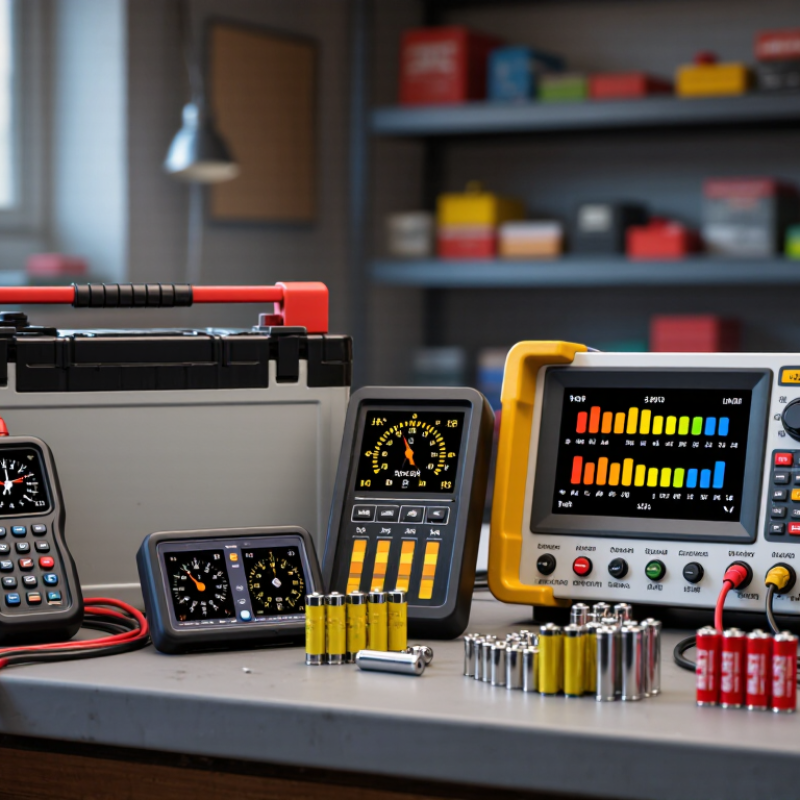
A useful battery tester should measure more than a bright voltage number. During practical testing, I check voltage at rest, under load, and after recovery. A healthy cell may show normal voltage but collapse quickly under a modest load. That difference often reveals aging or poor connections. The display can lie.
Capacity is usually reported in ampere-hours, but the test method matters. I use a controlled discharge current and record the cutoff voltage, elapsed time, and temperature. Capacity changes with discharge rate and temperature. A battery rated at 2 Ah may deliver less in cold conditions or under heavy demand. Energy is better compared in watt-hours because voltage changes during discharge.
Current measurement confirms whether the tester applies the intended load. Even a small error can distort the final capacity result. Internal resistance adds another useful clue. A pulse test measures voltage drop against current, but cable resistance and dirty contacts can produce false readings. Clean terminals and firm connections matter. Measure twice.
No single tester is best for every battery type. I prefer equipment with stable current control, clear data logging, repeatable cutoff settings, and protection against reversed connections. Readings should be compared with the battery’s technical specification, not judged in isolation. My own tests are not perfect; temperature drift and contact pressure still affect results. A careful tester exposes those limits instead of hiding them.

Capacity testing becomes meaningful only when the method is controlled.
IEC 61960 specifies a standardized 0.2C discharge rate for comparable lithium secondary battery measurements. For a 5 Ah cell, that means a steady 1 A load. The tester should maintain constant current, record voltage accurately, and stop at the specified end voltage. Temperature matters too. A stable chamber near 20°C reduces misleading capacity gains caused by warmer conditions.
The International Energy Agency reported nearly 750 GWh of global electric vehicle battery demand in 2023. That scale increases the need for repeatable cell screening and production verification. A capable tester should offer calibrated current channels, synchronized data logging, thermal monitoring, and clear cycle records. Resolution alone does not prove quality. Traceability does.
A practical test setup needs patience.
Let the cell rest after charging, then begin the 0.2C discharge without hidden load changes. Watch the voltage curve, not only the final ampere-hours. A sharp early voltage drop may reveal aging or high internal resistance. No tester is perfect. Even a strong system can produce questionable results when fixtures are loose, cables warm up, or calibration is overdue. I would compare repeated runs, inspect the raw data, and document every cutoff setting. The best choice is the tester that makes errors visible.
A battery tester is only useful when its readings remain trustworthy. Four-wire measurement improves accuracy by separating current-carrying leads from voltage-sensing leads. This reduces errors caused by cable resistance, especially during high-current discharge tests. It also reveals small voltage changes that ordinary two-wire testing may hide. Resolution matters too. A display showing millivolts can expose a gradual voltage drop, but extra digits do not guarantee better accuracy.
Data logging adds another layer of evidence. Recording voltage, current, temperature, and time can show capacity loss, sudden heating, or unstable connections. In practical testing, I prefer a steady sampling interval rather than a crowded graph filled with noise. The setup still needs calibration, clean terminals, and consistent contact pressure. My early tests sometimes blamed the battery for strange results. Later, I found loose clips and unsuitable logging intervals. That mistake was useful.
Tips: Use short, equal-length sense leads. Check zero readings before each test. Compare repeated cycles, not one attractive result. Keep the test temperature stable. Leave enough logging memory for the full discharge. A higher resolution setting can also capture electrical noise, so inspect the signal before trusting every small change.
2026 Top Battery Testers: Which One Is Best?
Battery safety testing is no longer a simple pass-or-fail exercise. The International Energy Agency reported that global battery demand in the energy sector exceeded 750 GWh in 2023, increasing about 40% from 2022. More cells require more disciplined verification. A capable battery tester should support IEC 62133-2 procedures, including overcharge, external short circuit, vibration, mechanical shock, and thermal exposure. It must also record current, voltage, temperature, and test duration with clear traceability.
UN 38.3 focuses on transport safety. Its T.1 to T.8 sequence examines altitude simulation, thermal changes, vibration, shock, external short circuit, impact or crush, overcharge, and forced discharge. The United Nations Economic Commission for Europe continues to identify lithium battery transport as a major safety-control area in its dangerous-goods recommendations. A reliable tester should reproduce these conditions consistently, protect operators, and preserve raw data for independent review. Calibration matters. So does fixture design.
A perfect tester does not exist. Poor wiring can distort resistance readings, while slow thermal sensors may miss a dangerous temperature spike. That weakness deserves attention. Test teams should compare results with calibrated reference instruments and repeat borderline failures. The 2024 Battery Innovation Roadmap from the Global Battery Alliance also stresses stronger traceability and responsible battery value chains. In practice, the best system is not the fastest one. It is the one that exposes hidden failure modes, documents uncertainty, and supports defensible IEC 62133-2 and UN 38.3 evidence.
| Tester Type | Primary Safety Scope | Applicable Requirement | Key Test Conditions | Main Measurements | Typical Acceptance Evidence | Best Use Case | Overall Suitability |
|---|---|---|---|---|---|---|---|
| Programmable Battery Charge/Discharge Cycler | Electrical abuse, capacity, cycle life, charging and discharging behavior | IEC 62133-2: overcharge, forced discharge, continuous charging and electrical performance checks | Constant-current, constant-voltage and constant-power profiles; programmable voltage, current, time and cutoff limits | Voltage, current, capacity, energy, temperature, elapsed time and protection response | Recorded test profile, automatic cutoff, no leakage, venting, rupture, fire or explosion where prohibited by the applicable test | Routine qualification, design verification and production sampling | Best overall electrical tester |
| Environmental Chamber with Battery Cycling Interface | Thermal stability, temperature cycling and operation at temperature extremes | UN 38.3 T.2 Thermal Test; temperature-related portions of IEC 62133-2 | Alternating high and low temperature exposure using the current applicable UN 38.3 test schedule; controlled dwell and transition times | Chamber temperature, specimen temperature, voltage, current, pressure and visible condition | No leakage, venting, rupture, fire or explosion during or after the prescribed thermal sequence | Cell and battery transport qualification and thermal safety screening | Best for thermal verification |
| Vibration Test System | Mechanical integrity during transportation and repeated vibration | UN 38.3 T.3 Vibration; IEC 62133-2 mechanical safety provisions where applicable | Sinusoidal vibration swept across the specified frequency range, acceleration and duration in the current test method | Frequency, acceleration, displacement, fixture response, voltage and post-test condition | No leakage, venting, rupture, fire or explosion; electrical function remains within the applicable criteria | Transport simulation and enclosure or weld robustness studies | Best for transport vibration |
| Mechanical Shock and Impact Tester | Resistance to sudden acceleration, impact and mechanical abuse | UN 38.3 T.4 Shock; IEC 62133-2 mechanical shock and impact-related evaluations | Specified half-sine shock pulses, peak acceleration, pulse duration and number of impacts according to the applicable method | Peak acceleration, pulse duration, acceleration waveform, voltage and physical damage | No hazardous leakage, venting, rupture, fire or explosion; no unacceptable loss of containment | Packaged battery transport assessment and mechanical design validation | Best for impact resistance |
| External Short-Circuit Test Bench | High-current fault response, separator protection and thermal runaway prevention | UN 38.3 T.5 External Short Circuit; IEC 62133-2 external short-circuit test | Fully charged specimen connected through the resistance, duration and temperature conditions specified by the applicable standard | Short-circuit current, voltage, surface temperature, ambient temperature and test duration | No fire or explosion; temperature and post-test condition meet the applicable standard limits | Protection circuit, cell matching, busbar and enclosure safety verification | Best for fault-current safety |
| Crush and Impact Abuse Tester | Internal short-circuit risk caused by crushing, deformation or localized impact | UN 38.3 T.6 Impact/Crush; IEC 62133-2 crush and mechanical abuse evaluations | Controlled impact or crush using the specified force, geometry, speed, displacement and specimen orientation | Force, displacement, impact energy, temperature, voltage and visible damage | No fire or explosion and no unacceptable hazardous release under the applicable acceptance criteria | Pouch, cylindrical and prismatic cell mechanical safety development | Best for deformation testing |
| Overcharge and Forced-Discharge System | Failure response of cells, battery packs and protection systems under abnormal charging conditions | UN 38.3 T.7 Overcharge; UN 38.3 T.8 Forced Discharge for cells; IEC 62133-2 overcharge and forced-discharge tests | Programmable overcharge or forced-discharge current, voltage, duration and temperature according to the applicable standard | Voltage, current, temperature, time, protection activation and physical condition | No fire or explosion; no hazardous leakage, rupture or venting where prohibited by the applicable requirement | Battery-management-system validation and abuse-test qualification | Best for protection-system testing |
| Altitude Simulation Chamber | Low-pressure transport safety and container integrity | UN 38.3 T.1 Altitude Simulation | Reduced pressure equivalent to high-altitude transport for the specified duration, followed by inspection and electrical checks | Absolute pressure, pressure stability, specimen voltage, temperature and leakage indicators | No leakage, venting, rupture, fire or explosion; no unacceptable loss of electrical integrity | Air-transport qualification of cells and batteries | Best for low-pressure testing |
| Integrated Multi-Station Safety Test Platform | Combined electrical, thermal, mechanical and transport safety verification | A configured combination of IEC 62133-2 and UN 38.3 test methods | Multiple independent channels with programmable profiles, chamber integration, safety interlocks and synchronized data logging | Electrical, thermal, pressure, force, acceleration, displacement, event alarms and specimen images | Traceable records for each test step, calibrated sensors, controlled shutdown and standard-specific pass/fail assessment | Certification laboratories, advanced research and complete product qualification programs | Best for full compliance programs |
Choosing the best 2026 battery tester starts with chemistry, not screen size. Lithium-ion, LiFePO4, NiMH, and lead-acid batteries need different test methods. A voltage reading alone cannot identify chemistry or confirm usable capacity. The IEA’s Global EV Outlook 2025 reports that energy-sector battery demand exceeded 1 TWh in 2024. That scale makes accurate testing more important in workshops and storage systems.
For lead-acid batteries, select a tester with adjustable cold-cranking current and temperature compensation. For lithium batteries, prioritize capacity testing, internal-resistance measurement, and safe voltage limits. IEC 61960-3:2017 provides useful guidance for lithium-ion performance testing. Check the tester’s current range, discharge load, connector options, and data logging. A handheld unit may suit vehicle checks, while a programmable analyzer fits cells, packs, and laboratory work.
I still make one mistake. I sometimes trust a healthy voltage too quickly. Surface charge can create a misleading result after charging. Let the battery rest, record its temperature, and repeat the test under a controlled load. The U.S. Department of Energy’s battery research programs emphasize repeatable measurement and thermal control. A tester with calibration records is more reliable than one with impressive specifications. Choose the instrument for the test purpose: screening, capacity verification, fault diagnosis, or long-term research. No tester is perfect.
This comparison uses representative rechargeable-cell characteristics to show which measurements matter most when choosing a battery tester. Voltage-based testers are essential for lithium-ion cells, while capacity, internal resistance, cycle-life, and charge-discharge testing become increasingly important for evaluating long-term performance.
Cycle-life values are typical engineering ranges and vary with temperature, charge rate, discharge depth, cell design, and operating limits. Primary alkaline cells are excluded because they are not designed for repeated cycling.
Contact
KYOCERA SGS Precision Tools, Inc.
(330) 686-5700
150 Marc Drive
Cuyahoga Falls, OH 44223
Products
Resources